
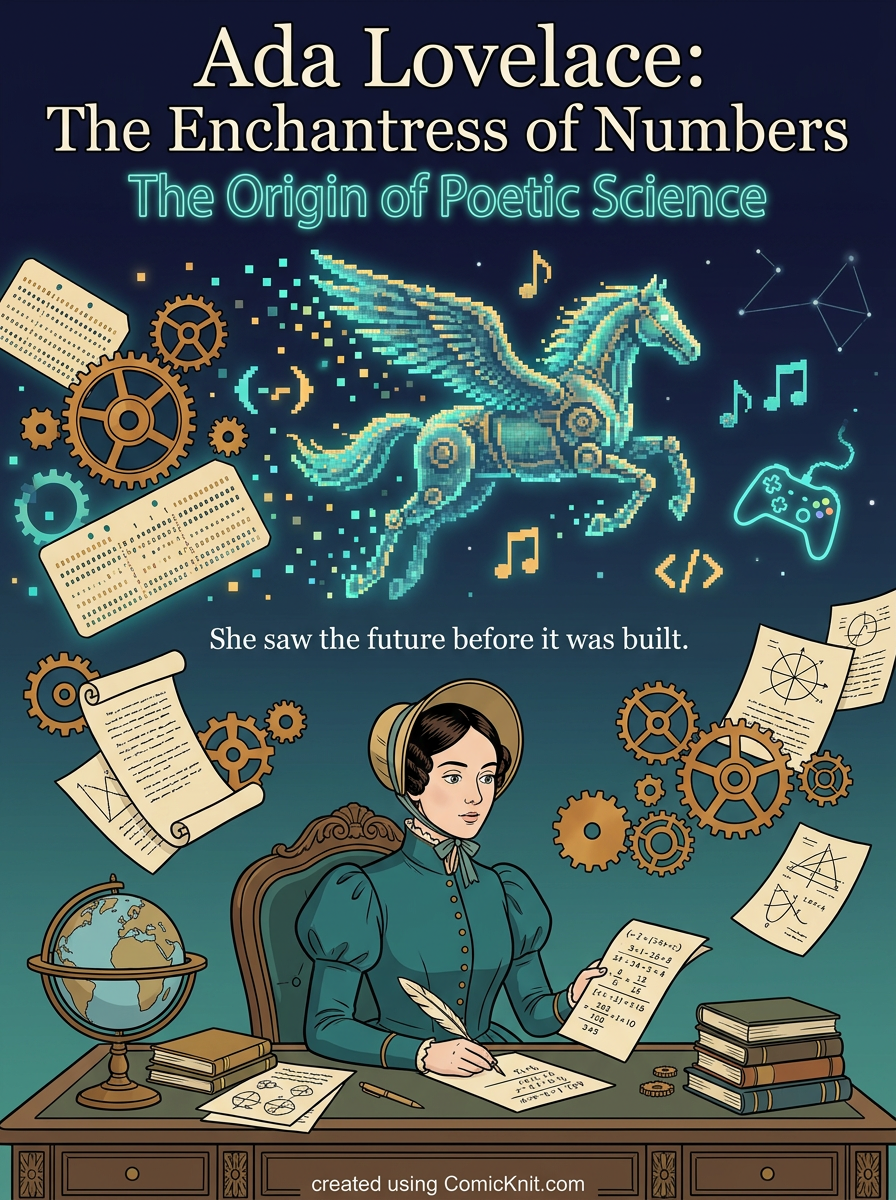
Ada Lovelace: The Enchantress of Numbers
The Origin of Poetic Science
Born to a wild poet and a strict mathematician, young Ada Byron discovers she possesses the unique power of 'Poetic Science.' From designing mechanical wings to writing the world's first computer program, Ada sees a future where machines create art and music long before the technology exists.
Read the transcript(text of every page of Ada Lovelace: The Enchantress of Numbers)
Page 1
London, 1815. A wild poet and a strict mathematician had a daughter.
Lady Byron—nicknamed 'The Princess of Parallelograms'—had one mission: keep Ada's mind on mathematics, far from her father's dangerous imagination.
Lady Byron (Annabella Milbanke): Focus, Ada. Numbers. Logic. Order. These are your tools.
Ada Lovelace (Augusta Ada Byron): Yes, Mother.
But you cannot lock away a true superpower. Logic and imagination did not fight inside Ada. They fused.
Page 2
Age 12. Measles left Ada paralyzed and bedridden for nearly a year. Her body was a prison. Her mind refused to stay inside.
Ada Lovelace (Augusta Ada Byron): If a rook's wing spans forty centimeters and lifts its body weight... then scaled up with steam power...
Sound effect: SCRATCH scratch scratch
She called her secret invention book 'Flyology.' Its ultimate dream: a giant, steam-powered mechanical flying horse.
Lady Byron closed the book. But the lock on Ada's imagination was already broken forever.
Lady Byron (Annabella Milbanke): Ada. Put that nonsense away. We return to Euclid tomorrow.
Ada Lovelace (Augusta Ada Byron): But Mother, I've already calculated the wing-to-weight ratio—
Lady Byron (Annabella Milbanke): Tomorrow. Euclid.
Page 3
London, 1833. Ada Byron, age 17, attends her first great society party.
Ada Lovelace (Augusta Ada Byron): What... is that?
Charles Babbage: —and the seventh-order differences resolve automatically! Automatically! Is that not magnificent?
Babbage was so astonished by her grasp of his machine that he gave her a name she would carry forever: 'The Enchantress of Numbers.'
Ada Lovelace (Augusta Ada Byron): Mr. Babbage—if the carry mechanism were extended to handle variable differences, could it solve differential equations?
Charles Babbage: I— yes. Yes, it could. How on earth do you—
Ada Lovelace (Augusta Ada Byron): And could that principle scale to any computable function?
Charles Babbage: You are the only person in England who has ever asked me that.
Page 4
1843. A French scientist had written a paper about Babbage's new design: the Analytical Engine—a theoretical machine that could execute any calculation using punch cards.
Charles Babbage: Ada, you were only meant to translate the paper into English. This stack is... three times the length of the original.
Ada Lovelace (Augusta Ada Byron): The translation is complete, Charles. What you are looking at now is what the paper should have said.
Sound effect: CLACK clack CLACK
Tucked inside 'Note G' was a flawless, step-by-step recipe to make the Engine compute Bernoulli numbers. It was the world's first computer program—written entirely in Ada's mind, for a machine that had not yet been built.
Charles Babbage: It is, at its heart, a calculator. The most powerful calculator ever conceived.
Ada Lovelace (Augusta Ada Byron): No, Charles.
Ada Lovelace (Augusta Ada Byron): It is an engine for any symbol that can be written down. Numbers—yes. But also musical notes.
Ada Lovelace (Augusta Ada Byron): Letters. Images. Anything a mind can describe, this machine could one day compose.
Page 5
Ada Lovelace passed away in 1852, age 36. The Analytical Engine was never built in her lifetime.
But today—every video game played, every song streamed, every line of code written on a tablet—
...is the exact future that Ada Lovelace—the original Enchantress of Numbers—saw in her mind over 180 years ago.