
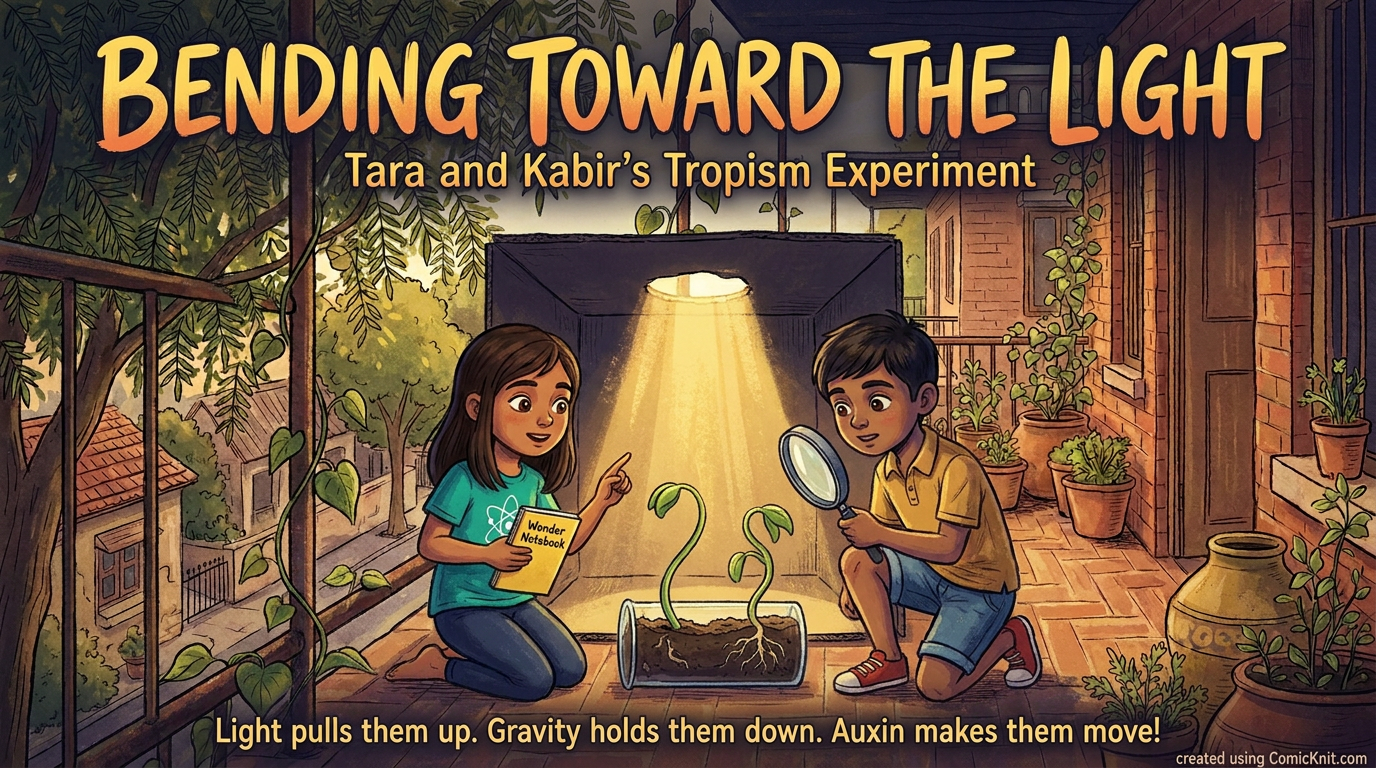
Bending Toward the Light
Tara and Kabir's Tropism Experiment
When eight-year-old Tara notices her balcony bean plant growing sideways toward sunlight, she and her inventive neighbor Kabir build an experiment to unravel how plants sense light and gravity. As they test phototropism and geotropism, Tara learns that scientific understanding requires patient observation rather than forced mechanical fixes. Together, they discover how the plant hormone auxin directs hidden cellular elongation to help shoots reach for the sun and roots anchor into the earth.
Read the transcript(text of every page of Bending Toward the Light)
Page 1
Tara: Notice how this stem isn't growing straight up! It's curving sharply toward the morning sun gap.
Sound effect: SCRATCH SCRATCH
Tara: Why would a plant waste energy bending sideways instead of reaching directly upward?
Page 2
Kabir: Maybe this stem is just lazy! What if we spin the pot around and see if it straightens?
Tara: Plants don't get lazy, Kabir. They respond to physical stimuli. We need a controlled test!
Kabir: Check this rig idea! We can build a light-proof maze box and force the seedling to search for light!
Tara: A phototropism chamber! If light directs shoot growth, the stem will bend toward our single light hole.
Page 3
Kabir: Light hole complete! I'll seal the lid with my heavy black electrical tape so zero room light leaks in.
Sound effect: SNIP SNIP
Tara: According to my hypothesis, phototropism will cause the stem cells on the dark side to grow longer.
Kabir: Let's leave it overnight in the sun. Tomorrow morning we open the maze!
Page 4
Tara: Look! The stem bent precisely toward the light hole! Positive phototropism in action!
Kabir: That shoot navigated the dark box like a radar guided missile!
Tara: Now for part two: geotropism! We place this pot horizontally to test gravity's pull.
Kabir: If gravity pulls down, will the stem bend down to the floor or reach back up?
Page 5
Kabir: Whoa—sorry! My foot caught the edge!
Tara: Careful! That soil spill exposed our specimen's roots!
Sound effect: THUMP CLATTER
Tara: Good science requires patience after a setback. We re-bed the roots and reset the horizontal vector.
Kabir: Got it steady now, Tara. Horizontal axis is re-aligned!
Page 6
Tara: Rainstorm coming! Grab the horizontal pot before the downpour washes away our soil setup!
Sound effect: RUMBLE PATTER
Kabir: Shelter secured! The pot stayed completely horizontal during the move.
Tara: Now we wait overnight. Gravity never stops pulling downward, even in the rain.
Page 7
Kabir: Look at that double curve! The stem went UP against gravity, but the roots turned DOWN toward earth!
Tara: Stems display negative geotropism, while roots display positive geotropism! It's controlled by plant hormones!
Tara: The secret is Auxin! Light moves auxin to the shaded side, making those cells grow longer and bend the stem!
Page 8
Kabir: If we tape this stem to a LEGO pole, it'll stand super straight and neat for our school exhibit!
Tara: Wait, Kabir! Taping it straight destroys the whole proof of geotropism!
Tara: I used to think science was about forcing perfect results quickly. But forcing a plant to look straight hides how it actually lives.
Page 9
Tara: No artificial braces! The real beauty of our experiment is showing auxin's natural response to gravity and light.
Kabir: You're right, Tara. The natural curve proves the plant is alive and sensing its world!
Sound effect: PEEL
Tara: Look at them both! Phototropism captures sunlight for photosynthesis, while geotropism anchors roots for water!
Page 10
Kabir: We built the best plant exhibit in Indiranagar! And zero tape forced on stems!
Tara: Science taught me that good observers ask, observe, compare, and let living systems tell their own story.
Tara: Shoots seek light, roots seek earth—and auxin guides every single cell along the way!