
Beyond the Saffron Robe: Decoding the Five Vedic Titles
A Guide to Pandit, Muni, Rishi, Sadhu, and Yogi
In an Ayurvedic orchard in Rishikesh, Vedacharya clarifies the distinct functional roles of Pandit, Muni, Rishi, Sadhu, and Yogi for a group of curious tourists.
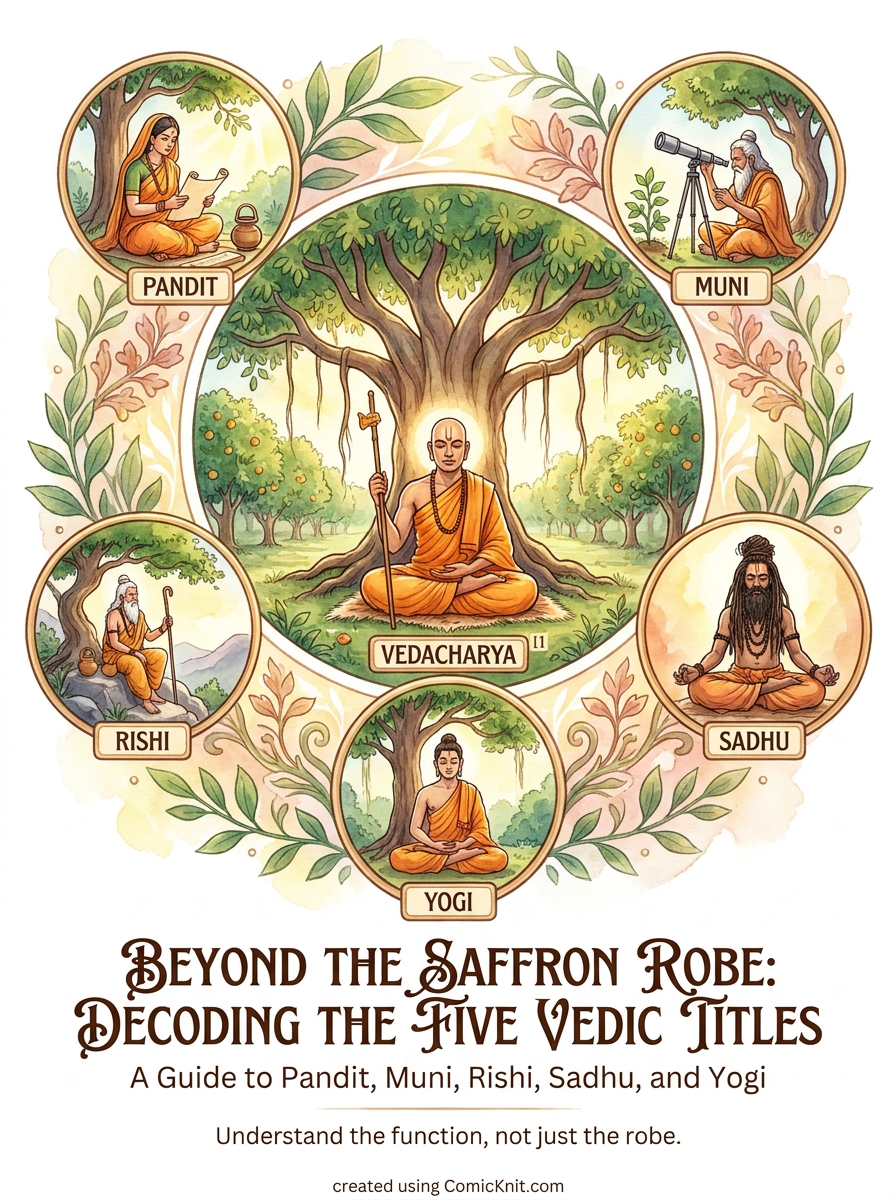
Read the transcript(text of every page of Beyond the Saffron Robe: Decoding the Five Vedic Titles)
Key facts
- A Pandit is an expert in published knowledge whose role is to impart existing knowledge to commoners without conducting research.
- A Rishi is a researcher and scientist who creates new knowledge.
- A Muni is a hermit who lives in solitude and hermitage, practicing inner contemplation/silence.
- A Sadhu is a spiritually elevated person who remains composed in all situations of life.
- A Yogi is one who practices yoga—the state of oneness and union between mind, body, and nature.
Page 1
Sarah: Greetings! Are you the Pandit here—or should we say Yogi? Or Sadhu?
Liam: I wrote down Muni and Rishi too. Aren't they all terms for a sage in saffron?
Vedacharya: The cloth is identical, but the work is entirely distinct. Five titles mean five precise functions.
Maya: So appearance isn't the definition?
Vedacharya: Never. One preserves known wisdom, while another discovers truths unknown.
Page 2
Beyond visual appearances, traditional titles reflect specific intellectual and spiritual functions.
Vedacharya: Outer garments tell us nothing of function. Let us begin with how knowledge moves.
A Pandit masters and transmits existing published knowledge. A Rishi discovers underlying truths and generates new knowledge.
Liam: So a professor teaching established curriculum is a Pandit, but a laboratory researcher finding breakthroughs is a Rishi!
Vedacharya: Precisely. One preserves the map; the other explores new terrain. But what about the title for someone who seeks complete isolation?
Page 3
Vedacharya: Beyond scholarly study and original research, some turn entirely inward.
Vedacharya: A Muni is a hermit living in complete solitude, practicing inner contemplation and silence.
Sarah: So their title is defined by physical isolation and inner stillness, not by public teaching.
Vedacharya: Exactly. But if isolation defines a Muni, how is a Sadhu defined when living among crowds?
Page 4
Location changes, but inner state remains constant.
Vedacharya: A Sadhu is defined not by where he sits, but by how he stands when the storm arrives.
Sound effect: WHOOSH
A Sadhu is a spiritually elevated person who remains composed in all situations of life.
Equanimity replaces geographic isolation.
Maya: So whether in praise or crisis, a Sadhu’s mind never loses its baseline balance.
Vedacharya: Exactly. Mastery over reaction, not escape from reality.
Page 5
Vedacharya: Many mistake a Yogi for merely someone performing physical gymnastics. But physical posture is only one visible thread.
A Yogi is one who practices yoga—the active state of oneness and union between mind, body, and nature.
Liam: So while a Sadhu masters internal equanimity, a Yogi actively integrates internal awareness with external environment.
Vedacharya: Precisely. Alignment across all realms.
Page 6
Five distinct paths, carved by purpose rather than attire.
Vedacharya: When mapped side by side, every title describes a distinct cognitive function rather than a coat of paint.
Actions define the identity.
Vedacharya: Inner silence defines the Muni, emotional composure defines the Sadhu, and active integration defines the Yogi.
The pattern locks into place.
Sarah: So a scholar reciting ancient scriptures without original research is strictly a Pandit, regardless of where he sits!
Theory meets living reality.
Vedacharya: Precisely. But can you spot all five operating together right here in this garden?
Page 7
In a single living orchard, ancient functions unfold side by side.
Vedacharya: Look around our garden. All five functions operate right now in the exact same environment.
Maya: So the robe is irrelevant. The title belongs entirely to what a person actually does!
Vedacharya: Precisely. Outer appearance is mere cloth; purpose is the true identity.
Vedacharya: Tell me... do you think these five essential roles exist only within ancient traditions?
Page 8
The outer garb changes across eras, but human functions remain eternal.
Vedacharya: When you look past robes and titles, you see the actual function each person fulfills.
Sarah: We came seeing identical saffron robes, but we leave seeing an entire framework for humanity.
The ancient titles now offer a clear lens for reading the modern world.
Vedacharya: Go gently, seekers. Carry clarity into every realm you walk.