
Blueprint of Tomorrow
Model and Modeling in Action
When a dangerous crosswalk bottleneck outside Ala-Too Middle School causes daily traffic gridlock, teenage coder Aibek tries to fix it with rash real-world trial and error. After nearly causing an accident, he partners with methodical classmate Akylai to master the power of modeling—from material globes to Scratch computer simulations. By testing signal timings digitally, they solve the intersection chaos safely and effectively.
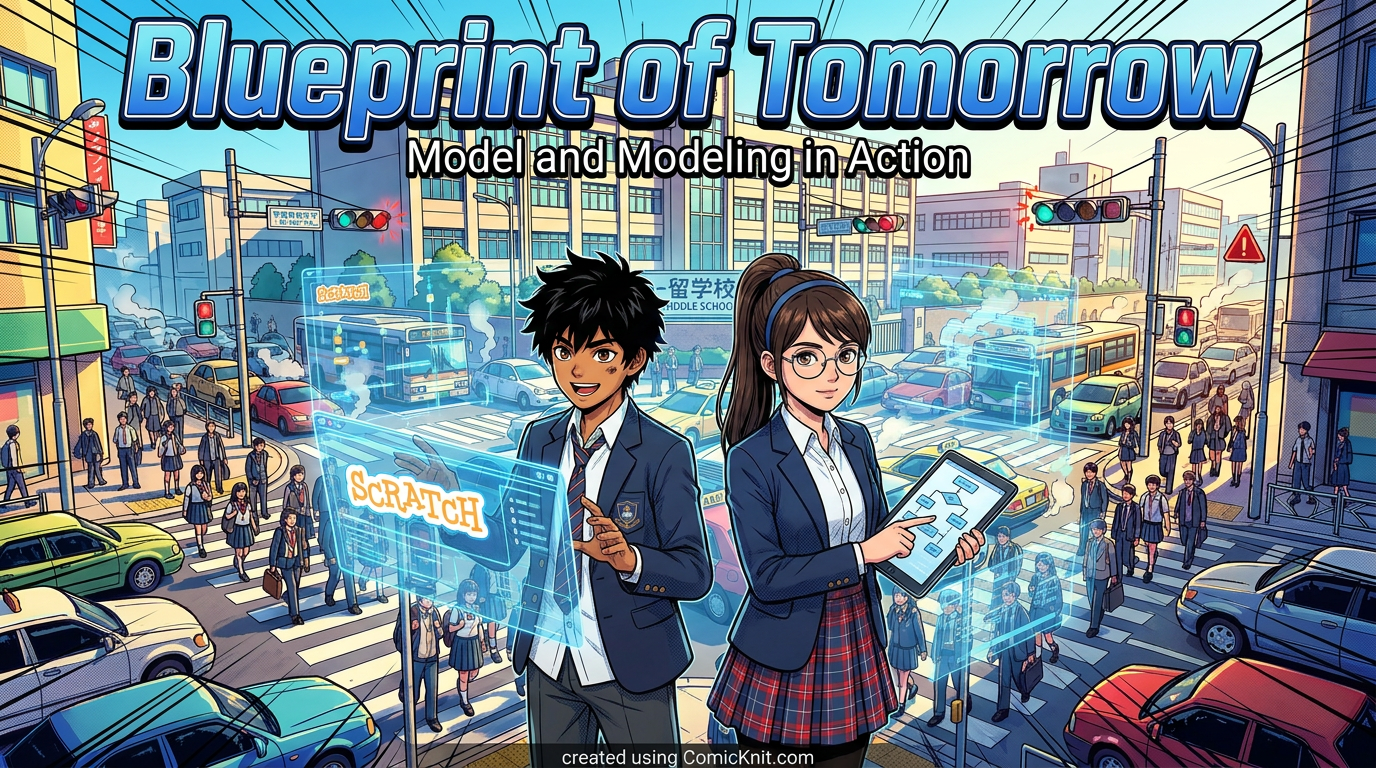
Read the transcript(text of every page of Blueprint of Tomorrow)
Page 1
Ala-Too Middle School crosswalk. 8:15 AM.
Aibek: Every single morning, this crosswalk turns into complete gridlock!
Sound effect: HONK! BEEP!
Aibek: The traffic light turns yellow for fifteen seconds, panicking drivers! Someone needs to step in and fix this right now!
Aibek: Whoa! That was way too close!
Sound effect: SCREECH!
Page 2
Aibek: Hold on! If the city won't fix it, I'll direct traffic manually right here!
Aibek: Wait—no! Stop! Turn left—I mean, wait!
Sound effect: BLARE! SCREECH!
Akylai: Aibek, stop! Testing ideas directly on real live traffic is dangerous and illegal!
Aibek: I was just trying to solve it!
Page 3
Akylai: You can't test complex systems in the real world first. You need a model!
Aibek: A model? Like a toy car? How does a toy help real traffic?
Akylai: A model is a simplified representation of a real object, phenomenon, or process that captures its essential features.
Akylai: A globe models the entire Earth. A blueprint models a skyscraper before construction starts. It allows us to study properties safely!
Aibek: So it captures what matters and leaves out the rest?
Page 4
Akylai: Models divide into two big groups: Material Models and Information Models.
Akylai: Material models are physical objects you touch—like globes or skeleton models. Information models describe objects with words, drawings, formulas, or computer code!
Aibek: Text, graphics, formulas, tables... and computer programs! That means code can model our intersection!
Page 5
1. Define Problem. 2. Study Object. 3. Create Model. 4. Study Model. 5. Draw Conclusions.
Akylai: To solve any problem, we follow the 5 Steps of Modeling!
Aibek: Step 1: Define the problem. Our goal is stopping traffic gridlock and crosswalk near-misses!
Akylai: Step 2: Study the object. Identify essential features: vehicle flow rate, signal durations, and pedestrian crossing time.
Page 6
Aibek: Step 3: Create the model! In Scratch, we can code a traffic light with Red, Yellow, and Green states!
Aibek: Red means stop. Yellow means prepare. Green means go. Simple rules, but let's see how they interact!
Aibek: Let's run the current real-world timing: 15 seconds Yellow, 10 seconds Green!
Page 7
Aibek: Yikes! Look at the simulation! The long yellow causes digital cars to stop mid-intersection, causing gridlock!
Sound effect: BEEP BEEP!
Akylai: Step 4: Study the model! Look at the graph data: a 15-second yellow light confuses drivers and starves pedestrian crosswalk time.
Aibek: And the best part? We crashed zero real cars finding this out! Let's optimize the loop!
Page 8
Aibek: I set Yellow to 3 seconds, Red to 25 seconds during pedestrian rush, and Green to 20 seconds!
Akylai: Zero bottleneck! Queue delay dropped by 80%! The computer model proves this timing works perfectly!
Aibek: Step 5: Draw conclusions! Modeling saves time, saves money, and keeps everyone completely safe!
Page 9
Akylai: Our computer model demonstrated that changing yellow timing to 3 seconds clears the bottleneck completely.
Aibek: Here is the exact algorithmic timing data from our Scratch simulation!
Aibek: They're updating the real signal box based on our digital model!
Sound effect: CLICK! BEEP!
Page 10
Akylai: Look at that! Perfect rhythm, zero congestion, and completely safe crossing!
Aibek: I get it now. Models let us understand complex reality, save time and money, and solve dangerous problems safely before touching a single real gear!
Aibek: Now... step 1 for our next model: solving the massive queue line at the school cafeteria lunch counter!
Akylai: Haha! I'll get the Scratch scripts ready!