
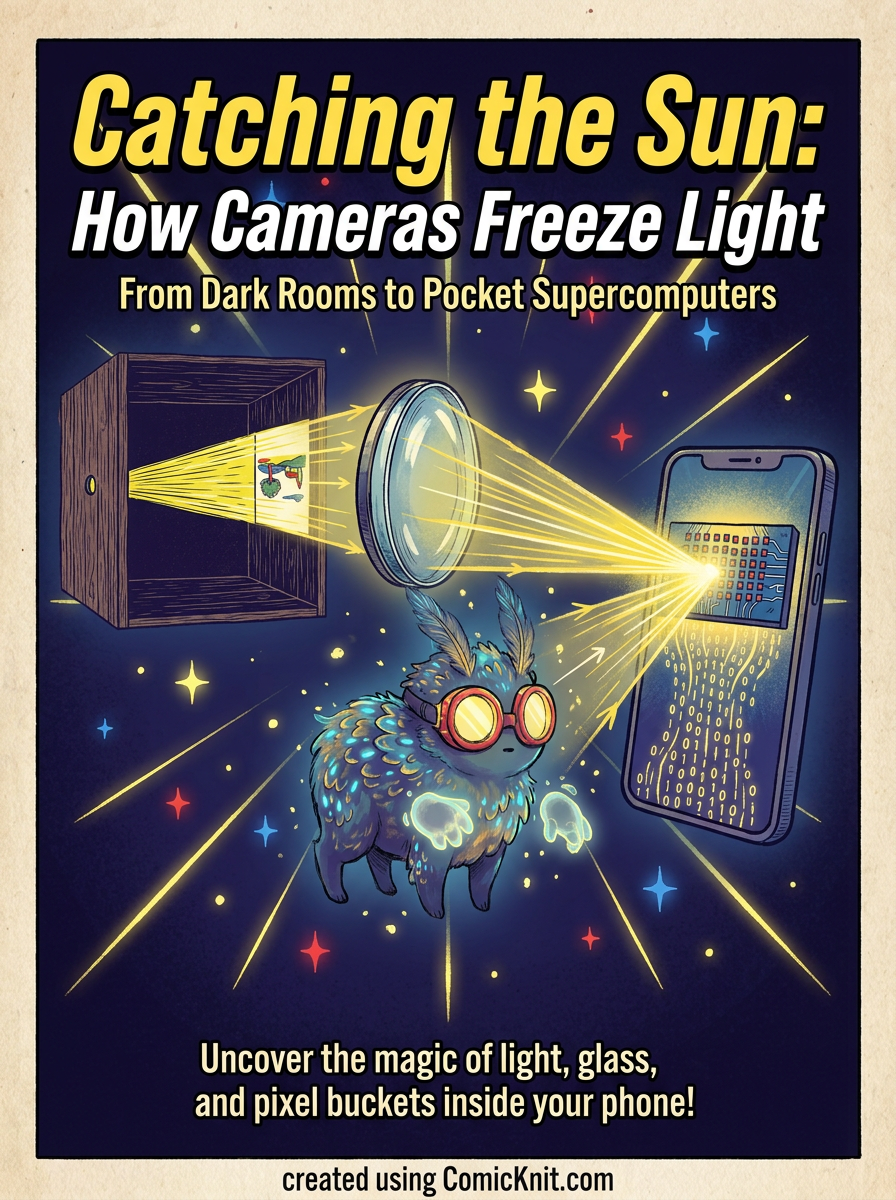
Catching the Sun: How Cameras Freeze Light
From Dark Rooms to Pocket Supercomputers
Join Lumi the light sprite on a journey through camera history and physics! Discover how light travels in straight lines, flips inside a camera obscura, bends through glass lenses, darkens chemical film, and turns into numbers inside modern smartphone sensors.
Read the transcript(text of every page of Catching the Sun: How Cameras Freeze Light)
Key facts
- Light travels in straight lines until it hits an object or changes mediums.
- A pinhole projects an upside-down (inverted) image because light rays cross paths at the opening.
- Glass lenses bend (refract) light to gather more rays into a bright, sharp focal point.
- Early film used silver halide crystals that turn dark when struck by photons.
- Digital camera sensors use micro-sensors (pixels) to convert light brightness into numerical data.
- Human eyes use a lens and light-sensitive retina in the exact same fundamental sequence as a camera.
Page 1
Welcome to the world of optics!
Lumi: Hi! I'm Lumi! Let's follow a beam of light on a wild trip!
Without light, there is nothing to see.
Lumi: Without light sources, nothing bounces into our eyes—or a camera lens!
Light always travels in straight lines until hit.
Lumi: A camera doesn't shoot light—it catches light bouncing off the world!
Sound effect: CLICK!
Capturing straight rays requires a clever trick...
Lumi: So how do we force those straight light rays into a full picture inside a box?
Page 2
Inside a sealed dark room, a single pinhole lets in a tiny slice of the outside world.
Lumi: Welcome to the 1500s! This entire dark room is a Camera Obscura—Latin for 'dark chamber'!
Because light travels in straight lines, rays from the top and bottom must cross paths right inside the pinhole.
The result is a perfectly projected upside-down picture on the opposite wall!
Lumi: Mind flipped yet? The light rays cross right in the middle of the hole!
Page 3
Lumi: Pinholes face a tough choice: go tiny for sharp focus, or wide for bright light!
Lumi: RETRIEVAL PUZZLE: Which card shows what happens when the pinhole is too large?
Lumi: Spot Card B! Extra light rays overlapping makes a blurry mess!
Lumi: Is there a magic tool that lets in lots of light without making the picture blurry?
Page 4
Lumi: Meet our hero: glass! Curved glass slows down and bends light rays, forcing them toward each other.
This bending is called refraction. A convex lens bends scattered light rays so they all meet at a single focal point.
Unlike a tiny pinhole, a wide glass lens collects tons of light without making the picture blurry!
Lumi: With a lens, we get bright light AND crisp detail! But what happens if our object moves closer or further away?
Page 5
First control: quantity. Widening the aperture allows more rays through, while narrowing it keeps out excess light.
Lumi: Aperture blades squeeze to control brightness!
Sound effect: CLICK-CLICK
Focus isn't magic—it's distance. Moving the lens shifts where bending rays converge.
Lumi: Slide the lens along the track until the light rays meet sharp!
Sound effect: SHRRRR-SCHLICK
Lumi: Now that we can project a focused light image, how do we freeze it so it doesn't vanish?
Page 6
Lumi: Photographers had to keep film in total darkness until clicking the shutter!
Film is coated with microscopic silver halide crystals that turn dark when struck by photons.
Chemical reactions freeze light forever. But what is the biggest weakness of storing photos with chemical crystals?
Lumi: When light hits silver crystals, they turn dark instantly!
Page 7
Chemical film only records light ONCE. Once those crystals turn dark, the chemical reaction is locked forever.
Lumi: Oops! Pulling film out in broad daylight floods every crystal at once!
Sound effect: ZAP!
How did modern engineers replace fragile chemical film with re-usable electronics?
Lumi: Unwanted sunlight turns the whole strip black! So if film is single-use and fragile...
Page 8
Welcome inside a modern digital CMOS sensor.
Lumi: Instead of chemical film, digital sensors use millions of microscopic light buckets called pixels!
Each pixel counts incoming light particles and turns brightness into exact numerical data.
Lumi: More light trapped means a higher number! Bright spots get big numbers, while shadows get zeroes.
Sound effect: BEEP BEEP
The phone reads millions of numbers instantly to build an upright screen image.
Lumi: Your photo isn't a continuous painting—it's a giant grid of numbers converted back into tiny colored tiles!
Page 9
Digital pictures don't paint lines—they group millions of tiny colored squares called pixels.
Lumi: Zoom in close enough and the illusion breaks into individual square tiles!
By combining glass lenses with micro CMOS sensors, pocket devices capture crisp scenes instantly.
Lumi: Modern phones stack tiny curved lenses right over that micro-sensor grid!
Smaller pixels allow a camera to sample fine details across the exact same sensor surface area.
Lumi: Which sensor captures finer zoom detail without looking blocky?
Lumi: Sensor B! More pixel buckets mean smaller color dots and sharper details!
Page 10
Lumi: Look in the mirror—you're holding the most advanced camera ever made!
Lumi: Your eye's lens focuses light upside-down onto your retina sensor, and your brain flips it!
You are now a certified light catcher and optics expert!
Lumi: Every snapshot starts with straight light rays bouncing off the world. Keep catching the sun!