
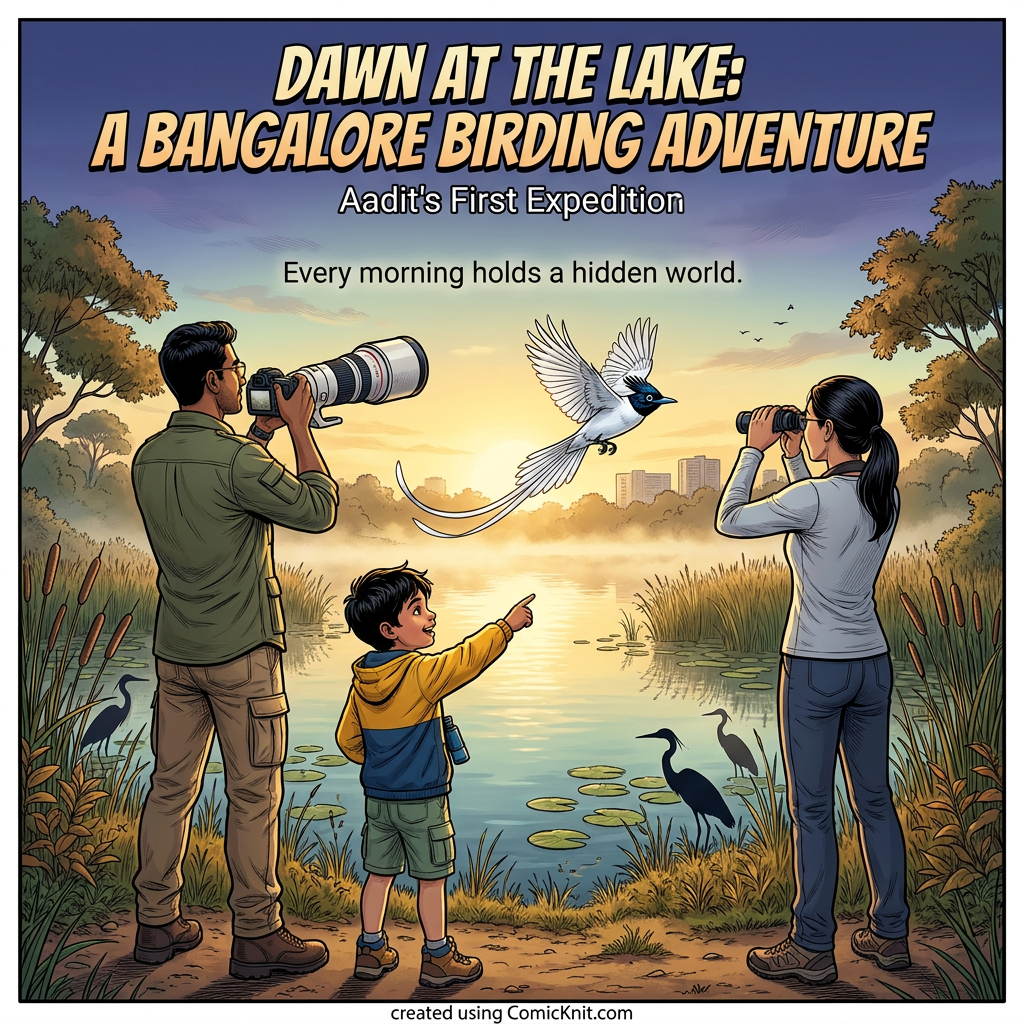
Dawn at the Lake: A Bangalore Birding Adventure
Aadit's First Expedition
Three-year-old Aadit and his parents set out at dawn to explore the vibrant birdlife surrounding a Bangalore lake. Guided by his father's expertise and his mother's keen eyes, Aadit learns the importance of observing wildlife from a distance. The morning culminates in the rare sighting of a stunning Asian Paradise Flycatcher.
Read the transcript(text of every page of Dawn at the Lake: A Bangalore Birding Adventure)
Page 1
Bangalore, India. 5:00 in the morning. The whole city is still asleep...
Dad: Battery — full. Memory card — ready. Big lens — check.
Aadit: Are we going now? Is it the birds?
Mom: Yes, Aadit. And remember — we use quiet voices today.
Page 2
The lake near Hebbal, Bangalore. 5:30 AM. The water is a mirror. The mist is a secret.
Aadit: Wow... it's so big!
Dad: This lake is home to hundreds of birds, Aadit. We are their guests. We walk slowly, speak softly, and stay on the path. Always.
The lake was already awake.
Page 3
The Great Egret. One of Bangalore's most graceful water birds.
It waits without moving — a master of patience.
Dad: Purple Heron. See how it hides in the reeds? Its colours are a perfect disguise.
Aadit: I see it! It has a stripey neck!
Mom: That's right. It's a Purple Heron — and it is watching us too.
Page 4
The Indian Cormorant dives deep to catch fish — but unlike ducks, its feathers are not waterproof. So it must dry its wings every morning.
The Spot-billed Pelican — one of India's largest water birds. Notice the spots on its orange beak!
Mom: The pelican scoops fish like a net. That big pouch can hold three buckets of water!
Aadit: THREE BUCKETS?
Spot-billed Pelican: Named for the dark spots on its bill. Found on lakes across South India.
Page 5
Mom: Aadit, look very carefully into the reeds. Something small and dark is moving.
The Common Moorhen. She has built her nest right on the water using reeds and twigs — and her chicks have just hatched.
Aadit: I want to see the baby birds closer!
Dad: I know. But if we step into the reeds, we could destroy the nest. Their home is as important as ours.
The moorhen chose the reeds for safety. Watching from a distance keeps the family safe — and keeps the chicks calm.
Page 6
The Bronze-winged Jacana — nicknamed the 'Lily-trotter' because it can walk on floating lily pads!
Its incredibly long toes spread its weight — like snowshoes, but for water!
Aadit: It's walking on the water, Amma!
Mom: Almost! Those big toes are its secret. It's one of the smartest birds on the lake.
Page 7
Near the lake's edge, the grasslands stretch open and wide. Different birds live here — ones built for open sky.
Dad: Stop. Look up — slowly.
The Marsh Harrier! It glides low over the grass — hunting by sight and sound. A true ruler of the open fields.
Aadit: It's flying so slow! Why doesn't it fall?
Dad: It uses the wind like a surfer uses a wave — reading every tiny puff of air.
Page 8
The Shikra — a small but fierce hawk found across India. Its red eyes can spot a lizard from fifty metres away.
Shikra means 'small hawk' in Hindi. It is a hunter — and also an important part of the lake ecosystem.
Dad: Raptors like the Shikra keep the ecosystem balanced. They eat insects and lizards — which keeps those populations healthy.
Aadit: Like a superhero for the lake?
Dad: Exactly. A superhero for the lake. That is exactly what it is.
Page 9
Aadit: Appa... when do we see the really really special bird?
Dad: Every bird we've seen is special. But there might be one more. We just have to look carefully.
Mom: Aadit, try your binoculars on that tree hollow. Stare at it. Don't blink.
Sound effect: ...
Page 10
The Spotted Owlet — a small owl that lives in tree hollows, old buildings, and rocky walls across India. Unlike most owls, it is sometimes active during the day.
This is a family — just like ours. The parents hunt at night. In the morning, they rest here, keeping their owlets safe.
Dad: The spots on its feathers look exactly like sunlight through leaves. That camouflage makes them invisible during the day — to stay safe.
Aadit: They're hiding! Like a game!
Aadit: We should be very quiet so we don't wake the baby owls.
Mom: That's exactly right.
Page 11
The shaded trail. Quiet. Cool. The kind of place shy birds like to hide.
Dad: I mentioned a special bird earlier. I've seen it here before, once. Very rare. But only if we are completely still and silent.
Sound effect: tsit-tsit-tsit
Page 12
Sound effect: fwip
Dad: Don't... move.
The Asian Paradise Flycatcher — male, white morph. One of India's most beautiful birds. Rare to see near Bangalore.
Page 13
It darts out to catch a flying insect — those long tail feathers streaming behind it like ribbons in the wind.
Aadit: Its tail... it's like a fairy's tail...
Page 14
Sound effect: fwwshh
Mom: In all the years we have come to this lake, we have seen that bird only twice. Today was for you, Aadit.
Aadit: Did it see us too?
Dad: Yes. And it stayed because you were quiet and still. You gave it the respect it needed. That's why it showed itself.
Page 15
8:00 AM. The lake is fully awake now. And so is Aadit.
Aadit: Now listen, Teddy. You must be VERY quiet. And you must never go close to the nest.
Mom: He's teaching the bear to be a birder.
Dad: He's a better teacher than me already.
The birds remain. The lake remains. All it asks is that we keep our distance — and keep coming back to learn.