
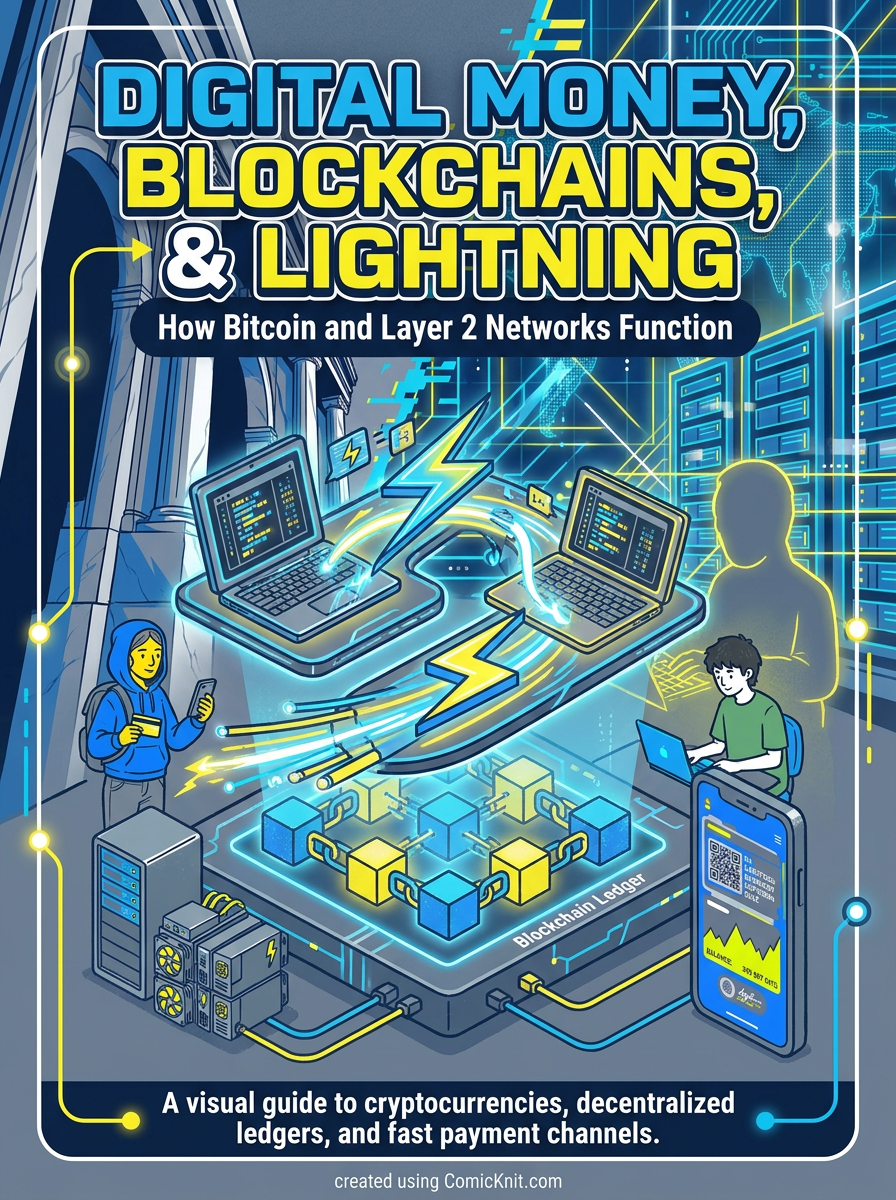
Digital Money, Blockchains, and Lightning
How Bitcoin and Layer 2 Networks Function
A visual, step-by-step breakdown of how cryptocurrencies operate, how Bitcoin maintains a secure global ledger, and how the Lightning Network enables instant everyday transactions.
Read the transcript(text of every page of Digital Money, Blockchains, and Lightning)
Key facts
- Regular money is created and managed by governments and banks, whereas cryptocurrency is digital money secured by cryptography.
- Crypto means secret or protected information, and currency means money; transactions can occur directly between users without a bank.
- Cryptocurrencies are stored in digital wallets, which hold private digital keys that control access rather than literal physical coins.
- Most cryptocurrencies use a blockchain, a shared digital record book replicated across thousands of independent computers.
- Transactions are grouped into blocks connected sequentially in a chain.
- Altering confirmed blockchain records is extremely difficult because it requires changing thousands of copies simultaneously.
- Bitcoin was introduced in 2009 by an individual or group using the pseudonymous name Satoshi Nakamoto.
- Bitcoin serves as a currency (BTC), a payment network, and a public record book without central bank control.
- Bitcoin is divisible into 100,000,000 satoshis (1 BTC = 100,000,000 satoshis).
- Nodes maintain and check copies of the blockchain, while miners compete to add new blocks of transactions.
- Bitcoin mining involves using powerful computers to solve mathematical puzzles to confirm transactions, earning new bitcoin and fees as rewards.
- Bitcoin supply is strictly limited to 21 million units under its current rules.
- Sending bitcoin requires a public address and a private key.
- The phrase 'Not your keys, not your coins' means third parties control your funds if you do not hold the private keys.
- The main Bitcoin network can become slow and expensive for tiny everyday purchases due to limited block space.
- The Lightning Network is a Layer 2 system built on top of Bitcoin for faster, cheaper, small-scale payments.
- Two participants open a Lightning payment channel by locking bitcoin in a special transaction, updating balances off-chain repeatedly.
- Payments can route through interconnected channels across multiple users without needing a direct channel to everyone.
- Scanning a Lightning QR code at a coffee shop allows instant payment confirmation compared to minutes on the main blockchain.
- Bitcoin is pseudonymous rather than fully anonymous because public addresses and transactions are visible on the blockchain.
- Key risks of cryptocurrency include price volatility, scams, permanent loss or theft of private keys, and irreversible transactions.
Page 1
Traditional money is issued and managed by central banks and governments. Cryptocurrency is digital money secured by math and computer networks.
'Crypto' means secret or protected information, while 'currency' means money. Together, they allow direct peer-to-peer transfers without middleman banks.
Cryptocurrencies are stored in digital wallets. Rather than holding physical coins, these wallets hold secret private keys that unlock and control your digital funds.
Page 2
Most cryptocurrencies use a blockchain: a shared digital record book replicated identically across thousands of independent computers worldwide.
Transactions are packed into blocks and chained together in strict chronological order.
Altering confirmed records is virtually impossible because an attacker would need to rewrite thousands of copies simultaneously.
Page 3
In 2009, an anonymous creator using the pseudonym Satoshi Nakamoto launched Bitcoin—the world's first decentralized digital currency.
Bitcoin operates as three interconnected systems in one: a digital asset, an open payment network, and a shared ledger.
Just like one Rupee splits into 100 Paise, a single Bitcoin divides into 100 million tiny units called satoshis, enabling tiny micropayments.
Page 4
The network relies on two key players: Nodes verify every transaction against the rules, while Miners bundle transactions into new blocks.
Miners race to solve complex mathematical puzzles (Proof-of-Work). The winner earns newly created bitcoin plus transaction fees, securing the network through energy and computation.
Sound effect: CLICK!
Unlike traditional fiat currencies printed by central banks, Bitcoin's total supply is mathematically hardcoded and capped forever.
Page 5
To transfer bitcoin, users utilize public key cryptography. Your public address acts like a public mailbox address, while your private key generates the secret signature required to spend funds.
If a third party holds your private keys, you do not truly control your money. Self-custody ensures full ownership of your assets.
Because mainnet block space is strictly limited, processing small everyday purchases directly on the main blockchain can be slow and prohibitively expensive.
Sound effect: TICK TOCK
Page 6
To solve mainnet slowness and high fees, developers created the Lightning Network—a Layer 2 system that processes fast, cheap transactions off the main blockchain.
Two people lock funds into a payment channel to exchange thousands of instant transactions off-chain, updating the main blockchain only when the tab is closed.
By connecting thousands of individual channels, the network routes payments across multiple hops automatically, allowing anyone to pay anyone instantly.
Sound effect: ZAP!
Page 7
Scanning a Lightning QR code at a coffee shop allows instant payment confirmation in seconds, avoiding the minutes-long settlement wait times of the main blockchain.
Sound effect: BEEP!
Mainnet provides final settlement and security, while Lightning offers everyday speed. Bitcoin is pseudonymous: public addresses are transparent, but personal identities are not.
Key risks of cryptocurrency include high price volatility, scams, permanent loss or theft of private keys, and irreversible transactions that cannot be undone.