
Plant Detectives: Monocots vs. Dicots!
Saffron's Flying Field Guide to Seeds, Leaves, Stems, and Roots
Read the transcript(text of every page of Plant Detectives: Monocots vs. Dicots!)
Key facts
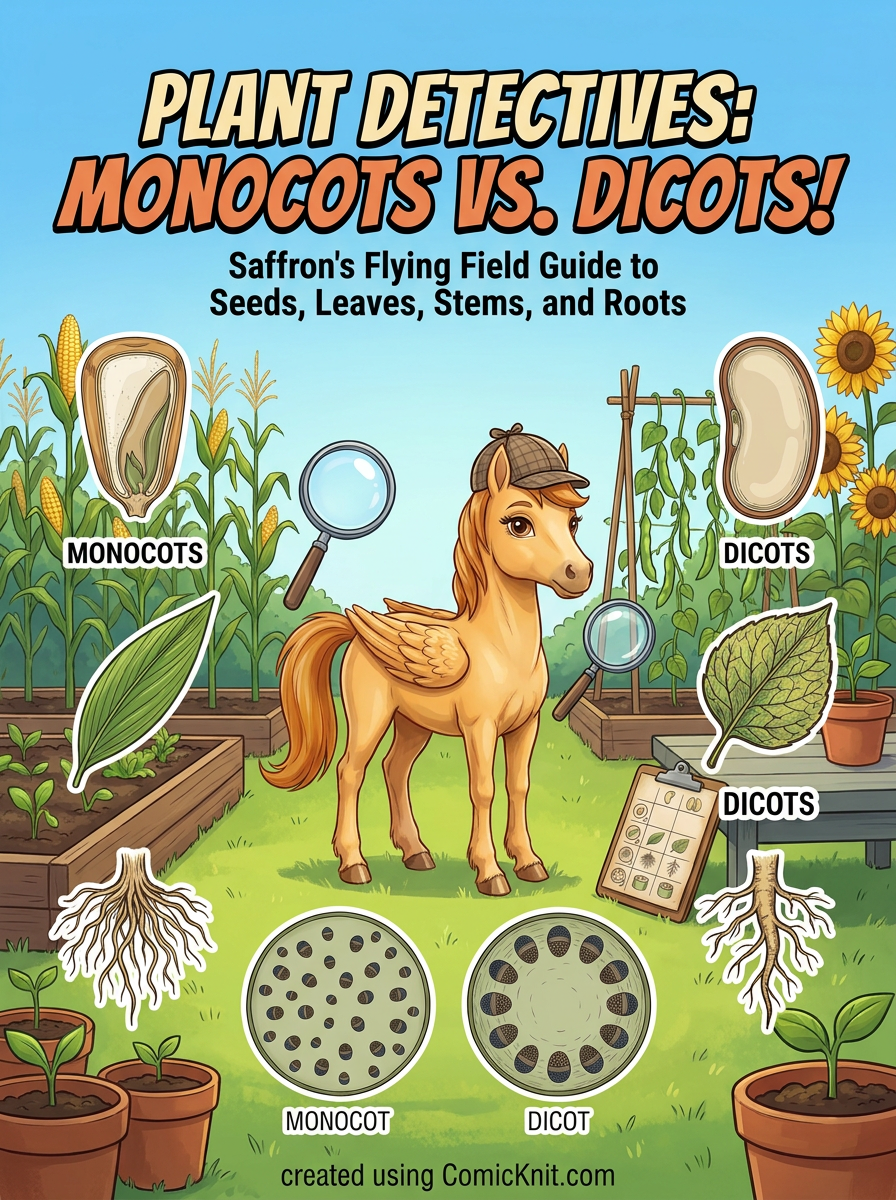
- Monocot seeds contain one cotyledon (seed leaf), while dicot seeds contain two cotyledons.
- Monocot leaves feature straight parallel veins, whereas dicot leaves have branching net veins.
- Monocot root systems are fibrous webs, whereas dicot root systems feature a main taproot.
- Monocot stem bundles are scattered randomly, while dicot stem bundles form a neat circular ring.
- Plant detectives can identify monocots and dicots using four clues: seed, leaf, stem, and root.
Page 1
Chapter 1: The Sprout Mystery! Why do some seeds sprout as single blades while others open in twin leaves?
saffron: Hello plant detectives! Every green plant belongs to one of two giant secret families!
Look closely at the soil surface. Before full leaves grow, the tiny plant reveals its family secret.
saffron: Notice that difference? One sprout started solo, but the other brought a twin!
Page 2
Chapter 2: Seed Clues! What is hiding inside a plant's first lunchbox?
saffron: Inside every seed sits a tiny food pack called a cotyledon, or seed leaf!
Mono means ONE. Monocots store food in 1 seed leaf. Di means TWO. Dicots have 2 seed leaves!
saffron: Soak a bean and it splits right into two halves! A corn kernel stays whole!
Page 3
Misconception check: People think all seeds split easily if you press them.
saffron: Try pressing a rice grain! It won't split in half because it's a Monocot!
Retrieval Practice: A peanut splits into two halves. An oat grain is a single solid piece. Which is the dicot?
saffron: Two halves mean TWO cotyledons! The peanut is our dicot champion!
Page 4
Chapter 3: Leaf Water Lines! Which way do the green water pipes flow?
saffron: You don't need to dig up seeds! Just look at the leaf in your hand!
Monocot leaves have parallel veins that run side by side like train tracks. Dicot leaves branch like tree limbs!
saffron: Grass blades have straight parallel lines! Sunflowers build a branching web network!
Page 5
Analogy alert: Leaf veins look like art lines, but they are actual hydraulic pipes carrying water.
saffron: These lines are pipes! Straight parallel pipes mean Monocot. Net webs mean Dicot!
Detective Challenge: Spot the Monocot! Look at the tulip leaf vs the rose leaf.
saffron: Tulip veins run straight side by side! That tulip is a Monocot detective clue!
Page 6
Chapter 4: Underground Secrets! What lies under the garden soil?
saffron: Down in the dark dirt, roots tell us the plant's family story too!
Monocots grow fibrous roots—a bushy web of equal strings. Dicots grow a taproot—one deep main central anchor!
saffron: Fibrous roots spread like a hairnet! Taproots anchor deep like a giant peg!
Page 7
Misconception: People think carrots are just vegetables, but a carrot is actually a giant taproot!
saffron: When you eat a carrot, you are eating a dicot's big central taproot!
Application Beat: Which root system holds topsoil together best during heavy rain?
saffron: The fibrous root web of grass grabs topsoil like a tight blanket to stop erosion!
Page 8
Chapter 5: Inside the Stem! How are the drinking straws arranged?
saffron: Stems carry water up and sugar down through tiny straw bundles!
In Monocot stems, water pipes are scattered randomly. In Dicot stems, water pipes form a neat circular ring!
saffron: Polka-dot dots mean Monocot! A neat outer ring of straws means Dicot!
Page 9
Look at a celery cross-section dipped in food dye. Notice where the red dots sit!
saffron: See those dots forming a circle near the edge? Celery is a classic dicot!
The 4-Clue Detective Rule: Seed + Leaf + Root + Stem.
saffron: Monocot: 1 seed leaf, parallel veins, fibrous roots, scattered pipes!
saffron: Dicot: 2 seed leaves, net veins, taproot, ring pipes!
Page 10
Chapter 6: Kitchen Detective Transfer! Can you classify these grocery vegetables?
saffron: Time for the ultimate test! Let's examine our kitchen mystery plants!
Green Onion: straight leaf veins and hairy root beard = MONOCOT! Carrot: net leafy top and deep taproot = DICOT!
saffron: You are now a certified Plant Detective! You can read any plant like a book!