
Saffron’s World Market: Why $1 Costs 80 Rupees!
A Kid’s Visual Guide to Foreign Money and Exchange Rates
Saffron the winged pony guides young readers through foreign currency, explaining why different unit sizes don't mean lower value, and how global market demand moves exchange rates up and down.
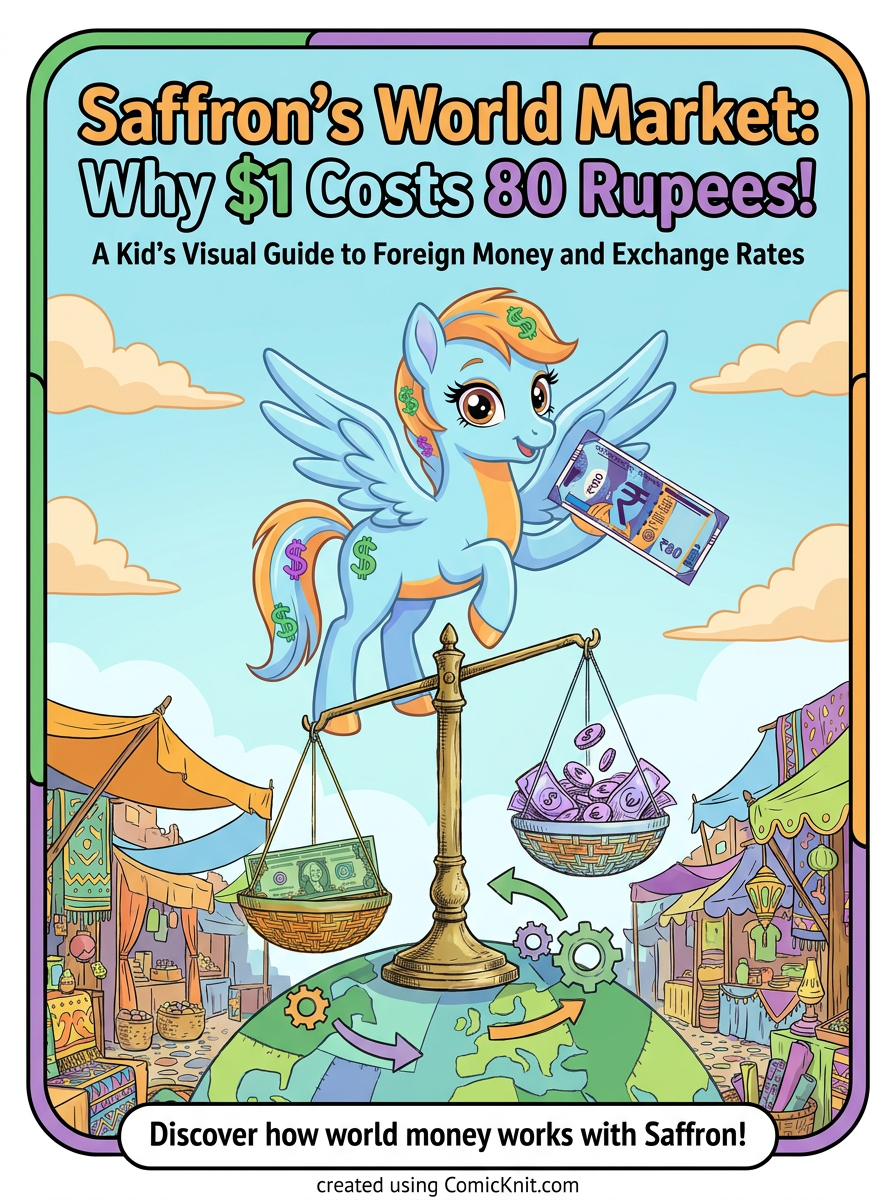
Read the transcript(text of every page of Saffron’s World Market: Why $1 Costs 80 Rupees!)
Key facts
- Different nations issue their own official currency units (e.g., Dollars in the USA, Rupees in India).
- Exchange numbers reflect different unit sizes; 100 centimeters equals 1 meter, but both describe the exact same length.
- An exchange rate is the price ratio at which one country's currency can be traded for another.
- To buy goods from another nation, international buyers must trade for that nation's currency, creating currency demand.
- High global demand for a currency relative to its supply causes its exchange value to rise (strengthen) against other currencies.
Page 1
Every nation uses its own official tickets for buying goods—we call them currencies!
saffron: Welcome to the World Market! Ever wondered how people shop around the globe?
saffron: Wait a second! Does an 80 Rupee toy really cost 80 times as much as a 1 Dollar toy?
Page 2
saffron: A bigger number doesn't mean a bigger price! It just means a smaller unit of measure.
Exchange numbers reflect different unit sizes; 100 centimeters equals 1 meter, but both describe the exact same length.
saffron: 1 meter is exactly as long as 100 centimeters. 100 is a bigger number, but the length is identical!
saffron: Quick check! Is a 15-centimeter pencil longer than a 1-meter stick?
Page 3
saffron: When you travel or buy across borders, you swap your home money at an Exchange Counter!
An exchange rate is the price ratio at which one country's currency trades for another.
saffron: Insert one $1 bill, and out pop 80 Rupees! This fixed conversion ratio is the exchange rate.
saffron: Your turn! If $1 buys 80 Rupees, how many Rupees will you get if you insert $3?
saffron: That's 3 times 80... exactly 240 Rupees! You've got it!
saffron: Wait... look at the board! Why doesn't this exchange rate number stay fixed forever?
Sound effect: BEEP BEEP!
Page 4
saffron: Exchange rates don't stay locked in place forever! They tilt up and down every single day.
When people in other countries want to buy goods like delicious tea or handcrafted toys from India, they can't pay with their home cash.
To buy goods from another nation, international buyers must trade for that nation's currency, creating currency demand.
saffron: To buy those goods, foreign shoppers must swap their money for Indian Rupees first! That creates high demand for Rupees.
saffron: So who actually controls whether the currency balance tips up or down?
Page 5
Exchange rates aren't set by decree. Real trade sets the scale.
saffron: No official just sits at a desk twisting a secret magic knob to change global rates!
When global demand for a currency jumps, its value rises against others.
saffron: When everyone wants Rupees to buy awesome goods, high demand makes that ticket stronger!
saffron: Ready to test your market skills? Time to put on your detective hat!
Page 6
CASE FILE: THE HIT VIDEO GAME LAUNCH
saffron: Time to put on your Currency Detective hat! Let's solve a real-world mystery together.
A game studio in India releases a blockbuster hit! Millions of players worldwide want to buy it immediately.
OPTION A: Rupee value drops! | OPTION B: Rupee value rises!
saffron: To buy this game, global players need Indian Rupees. What happens to the demand and value of the Rupee?
High demand for exports strengthens a nation's currency unit value on global markets.
saffron: Option B! Huge demand for the game drives up demand for Rupees, making the Rupee stronger!
saffron: You nailed it! But guess what? You already use this exact supply-and-demand trick closer to home...
Sound effect: DING DING DING!
Page 7
Everyday unit scales follow the exact same trade logic.
saffron: It's just like the arcade! One shiny token buys ten tickets, but both buy the exact same prize values.
Sound effect: CLINK!
saffron: When world demand moves, the exchange balance shifts. You're officially a currency detective!
saffron: Now go show off your global money mastery! Who will you teach first?