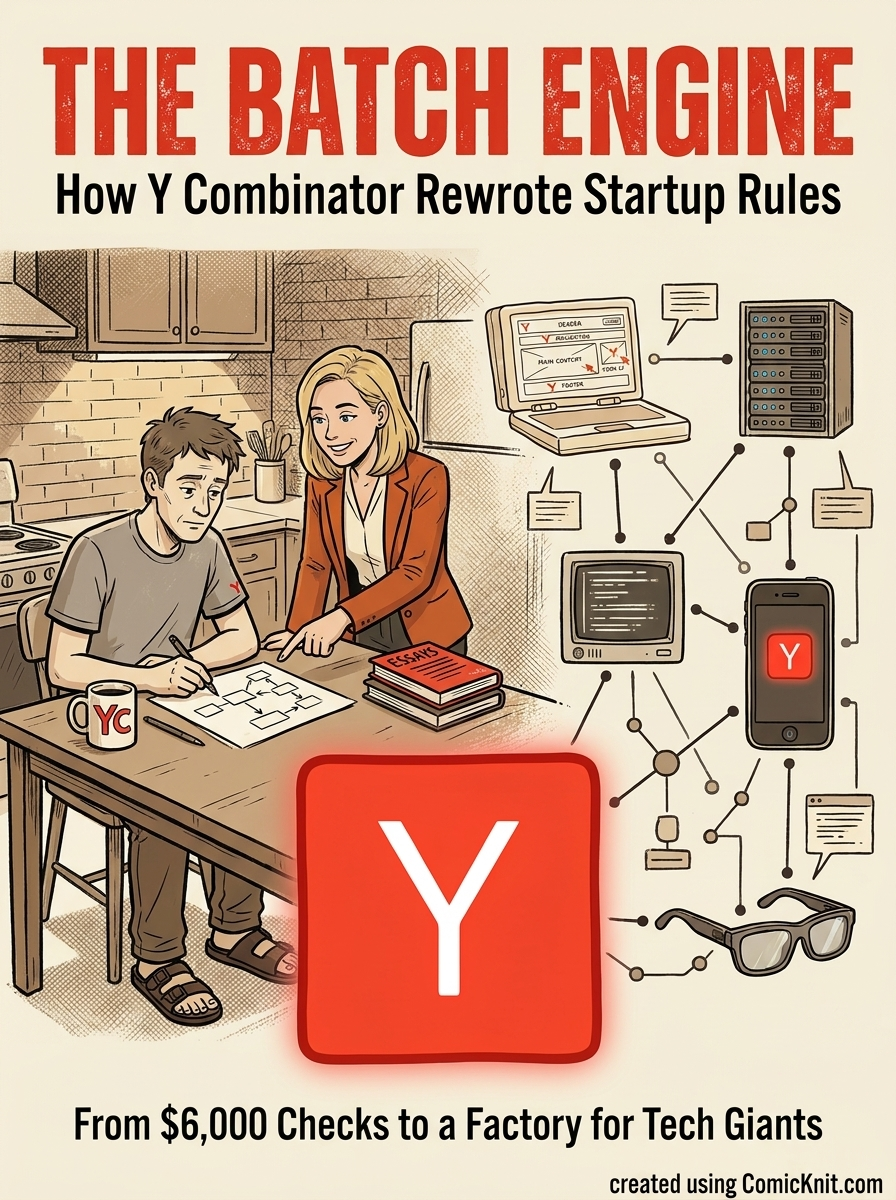
The Batch Engine: How Y Combinator Rewrote Startup Rules
From $6,000 Checks to a Factory for Tech Giants
Trace how Y Combinator replaced secret, high-capital venture investments with standardized batch cohorts, rapid user feedback loops, and aggregated Demo Days.
Read the transcript(text of every page of The Batch Engine: How Y Combinator Rewrote Startup Rules)
Key facts
- Paul Graham sold Viaweb to Yahoo in 1998 for $49 million.
- Y Combinator was founded in March 2005 in Cambridge, Massachusetts, by Paul Graham, Jessica Livingston, Robert Tappan Morris, and Trevor Blackwell.
- YC's initial 2005 Summer Founders Program invested $6,000 per founder in exchange for roughly 6–7% equity.
- Reddit (2005), Dropbox (2007), and Airbnb (2009) were early YC batch companies.
- YC introduced a synchronized batch schedule ending in a single Demo Day where founders pitched to many investors simultaneously.
Page 1
In 2005, launching a tech company required formal boardrooms, endless pitch cycles, and massive initial capital.
Paul Graham: Traditional venture capital needed millions just to test an idea. What if we tried the exact opposite?
Small micro-funding paired with rapid execution speed didn't just cut costs—it flipped the risk model completely.
Paul Graham: Tiny checks, a fixed deadline, and absolute focus on building things users actually want. That’s the real hedge against risk.
Page 2
In March 2005, following his $49M sale of Viaweb to Yahoo, Paul Graham co-founded Y Combinator in Cambridge, MA with Jessica Livingston, Robert Tappan Morris, and Trevor Blackwell.
Paul Graham: After Viaweb, I realized capital wasn't the hard part. The real bottleneck was helping founders make something people actually want.
Jessica Livingston: If we fund them all at once, we can streamline the entire process like an incoming university class.
Instead of scattered, individual angel investments, eight teams were assembled into a single, synchronized summer batch.
Paul Graham: Welcome to the Summer Founders Program. You're not individual deals—you're a synchronized cohort.
Page 3
In 2005, seed investing meant bespoke legal negotiations for every single company—costing thousands in attorney fees before a line of code was written.
Jessica Livingston: If every startup receives the exact same deal, we don't spend months arguing with lawyers. We invest Monday and start building Tuesday.
Page 4
In 2005, open-source software eliminated millions in startup overhead, transforming capital from a barrier into a timer.
Paul Graham: Six thousand dollars per founder wasn't for buying servers—it was twelve weeks of ramen and rent.
Which company discovers if anyone actually wants their product before running out of money?
Page 5
By stripping away complex corporate strategy, Y Combinator reduced early-stage survival to a continuous engine of rapid iteration.
Paul Graham: Most early startups die because they build things no one wants. In these 12 weeks, only two things matter: writing code and talking to users.
Yet founders still feared external execution threats over their own internal mistakes.
Paul Graham: If you aren't talking to customers, you're just guessing. Feature polish won't save a product nobody asked for.
Page 6
RETRIEVAL CHECK: What killed this product—a ruthless rival, or a failure to make something people want?
Jessica Livingston: Founders spend months worrying about Google copying them. But startups almost never die of homicide.
Jessica Livingston: They die of suicide. Ten thousand people downloaded this app on day one, but zero returned by day thirty.
Page 7
Isolated founders drift. Synchronized cohorts construct a social clock that transforms passive ambition into weekly execution.
Jessica Livingston: Every Tuesday, every founder states their numbers in front of everyone else.
Paul Graham: Nothing accelerates progress quite like having to face your peers every seven days.
The entire 12-week batch is engineered around a synchronized schedule ending in a single Demo Day where startups present together.
Page 8
In 2005, critics claimed small investments yielded small ideas. Early batch graduates like Reddit, Dropbox, and Airbnb proved high-velocity focus scales exponentially.
Paul Graham: By aggregating dozens of validated startups into a single presentation day, leverage completely inverted.
Page 9
The YC engine functions as a closed loop, converting batch momentum into founder leverage.
Paul Graham: None of these steps work in isolation. The batch momentum feeds the next wave of founders.
Jessica Livingston: And alumni backing brings even stronger cohorts every single cycle.
Early valuation shifts from theoretical market predictions to measurable user retention.
Jessica Livingston: Which company proves real traction?
Paul Graham: Theoretical market size means nothing without sustained user growth.
Page 10
By standardizing micro-capital and cohort synchronization, hard tech and scientific research bypass years of grant bureaucracy.
Paul Graham: The mechanism isn't about software code. It's about forcing brief, structured experiments against immediate reality.
Make something people want.
Paul Graham: It always comes back to the same fundamental engine.