
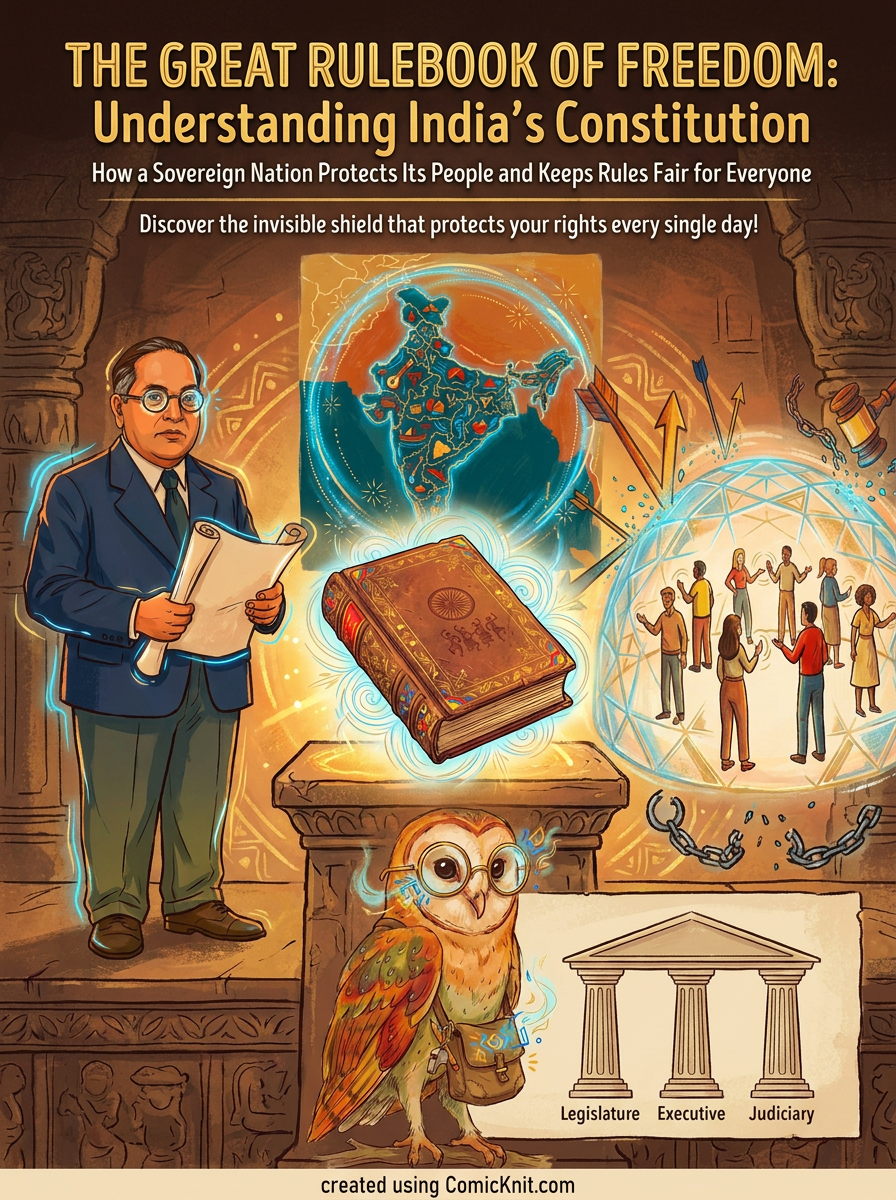
The Great Rulebook of Freedom: Understanding India's Constitution
How a Sovereign Nation Protects Its People and Keeps Rules Fair for Everyone
You will discover what makes a nation sovereign, why India created its supreme rulebook, and how the Constitution acts as an invisible shield protecting your rights every day.
Read the transcript(text of every page of The Great Rulebook of Freedom: Understanding India's Constitution)
Key facts
- A sovereign nation governs itself independently without external rule.
- A constitution is the supreme master rulebook that structures government and limits its power.
- India gained independence in 1947 and adopted its Constitution on January 26, 1950.
- Dr. B.R. Ambedkar served as the Chairman of the Drafting Committee for India's Constitution.
- The Constitution guarantees Fundamental Rights (such as equality and freedom) to all citizens.
- India's government is divided into three branches: Legislature, Executive, and Judiciary.
- The Supreme Court of India can strike down any law that violates the Constitution.
Page 1
Kitu the Wise Owl: Out! You crossed the secret safe line! New rule: I decide the safe zone!
Sound effect: TAG!
Kitu the Wise Owl: Doesn't feel very fair, does it? When the biggest player invents rules as they go, nobody else can ever win.
Kitu the Wise Owl: Without fixed rules, strength replaces fairness. But when rules bind everyone equally—even the strongest—the game finally works.
Kitu the Wise Owl: Games are easy enough to fix... but how does a whole country decide on its own rules without an outside boss?
Sound effect: TWEEEEET!
Page 2
Kitu the Wise Owl: Imagine living in a house where an outside landlord tells you when to sleep, eat, and speak!
Kitu the Wise Owl: Now imagine owning your home completely. You write the family rules together!
Sovereignty means a nation governs itself independently, without any foreign power making its laws.
Kitu the Wise Owl: That's exactly what sovereignty means: We are our own boss!
Kitu the Wise Owl: So no outside ruler can boss us around. But what happens if our OWN newly chosen leaders start making unfair rules?
Page 4
Not all rules are created equal.
Kitu the Wise Owl: Daily laws tell citizens how to drive or trade. But who tells the lawmakers what they can and cannot do?
A constitution is the supreme master rulebook that structures government and limits its power.
Kitu the Wise Owl: That's the Constitution! It is the supreme master rulebook that binds the government itself.
The master rulebook acts as a shield, ensuring no lawmaker can place themselves above fairness.
Kitu the Wise Owl: If a government official writes an unfair rule, it breaks against the Constitution like glass!
Sound effect: CLINK!
Every nation must choose its moment to set its master rules in stone.
Kitu the Wise Owl: So when did India build this magnificent shield for its own people?
Page 5
Kitu the Wise Owl: Before 1947, external rulers made India's laws. But winning independence meant writing our own rules!
India gained independence in 1947 and officially adopted its Constitution on January 26, 1950.
Kitu the Wise Owl: Every Republic Day parade celebrates the exact moment our master rulebook came into action!
Kitu the Wise Owl: Over 300 million diverse people joined under one supreme promise of equality and freedom.
Kitu the Wise Owl: Who were the visionaries who wrote this massive book, and how did they make sure it was fair for everyone?
Page 6
Kitu the Wise Owl: Writing a supreme rulebook for nearly four hundred million people didn't happen by royal command. It took teamwork!
Dr. B. R. Ambedkar: We are carving a path where every citizen, regardless of status, stands equal under one supreme law.
Kitu the Wise Owl: Every line was debated, questioned, and polished until everyone agreed on a fair foundation.
Dr. B. R. Ambedkar: This book belongs to the people. Within it lie the promises that guard your everyday life.
Kitu the Wise Owl: Promises that protect us every day? Like what?
Page 7
Kitu the Wise Owl: Inside that great book, the framers placed something incredible for every single person.
The Constitution guarantees Fundamental Rights—like equality and freedom—to all citizens from the moment they are born.
Kitu the Wise Owl: These rights act like an invisible shield. But what if an important leader tries to ignore yours?
Page 8
Kitu the Wise Owl: What if a powerful leader passes an unfair rule, like banning girls from the library?
Kitu the Wise Owl: The shield breaks the unfair rule, not the citizen! Fundamental rights are supreme guarantees.
Kitu the Wise Owl: Which shield stopped the unfair library ban? And who actually steps in to enforce these shields if a lawmaker refuses to listen?
Page 9
Fact: India's government is divided into three branches: Legislature, Executive, and Judiciary.
Kitu the Wise Owl: To stop anyone from hoarding total power, India splits its government into three separate branches!
If lawmakers pass a rule that violates the Constitution, the Judiciary steps in as the neutral referee.
Sound effect: BLOCK!
Fact: The Supreme Court of India can strike down any law that violates the Constitution.
Kitu the Wise Owl: The referee's word is final! No law stands above our supreme rulebook.
Sound effect: STAMP!
Sound effect: TWEEET!
Page 10
Sovereignty belongs to you, the people. And your Constitution makes sure it stays that way.
Kitu the Wise Owl: When we all agree to rules together, nobody gets to be an unfair bully—not even the people in charge!
Now you are ready to be a champion of fair rules and democracy wherever you go!
Kitu the Wise Owl: So, whenever you see a game, a club, or a country... ask yourself: are the rules fair for everyone?