
The Melanin Spectrum
How Sun, Skin, and Geography Shaped Human Diversity
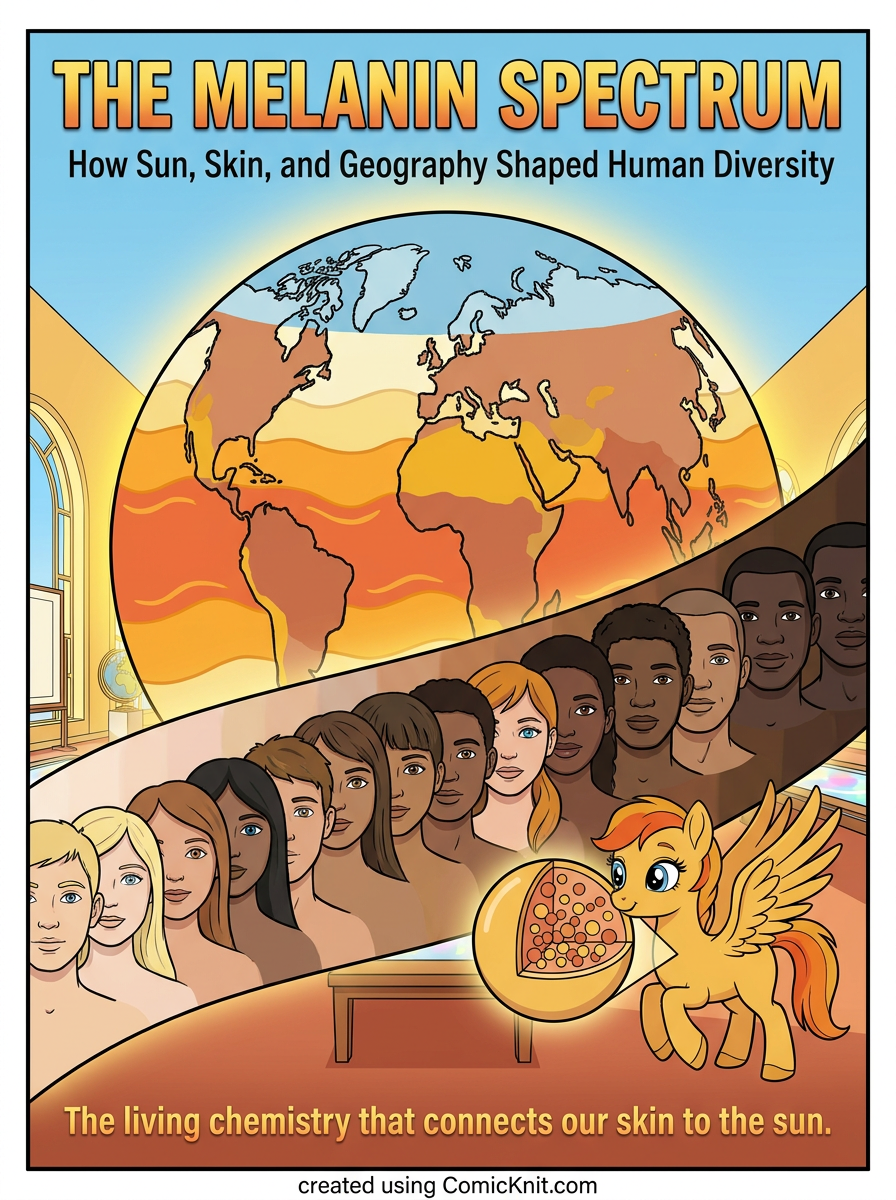
Guided by Saffron the winged pony, readers discover the biological chemistry of human pigment. Through clear diagrams and evolutionary geography, the book reveals how skin, eye, and hair colors emerged as an elegant global balancing act between sunlight, folate protection, and vitamin D synthesis.
Read the transcript(text of every page of The Melanin Spectrum)
Key facts
- Human skin colors form a continuous quantitative spectrum rather than separate discrete biological categories.
- Melanocytes produce two primary forms of melanin: brown-black eumelanin and yellow-red pheomelanin.
- Differences in skin, hair, and eye darkness result from the ratio, quantity, and distribution of melanosomes, not differing counts of melanocyte cells.
- Ultraviolet radiation breaks down folate in blood vessels near the skin surface, which can cause severe developmental defects during embryonic growth.
- Dense eumelanin acts as a natural sunscreen that shields circulating folate from photolysis by ultraviolet rays.
- Skin requires exposure to ultraviolet B (UVB) rays to synthesize Vitamin D3, essential for bone calcium absorption and immune function.
- Global levels of ultraviolet radiation correlate directly with latitude and altitude, creating an environmental gradient from the equator to the poles.
- As early humans migrated away from equatorial zones into regions with low UVR, selective pressure favored reduced pigmentation to prevent Vitamin D deficiency.
- There is no blue or green pigment in human eyes; light iris colors result from low melanin allowing Rayleigh scattering in the stroma.
- Hair color variations are determined by the ratio of eumelanin to pheomelanin in the hair cortex.
- Diets rich in marine mammals and fish provide abundant Vitamin D, reducing the evolutionary need for depigmentation in high-latitude Arctic peoples.
- Human pigmentation differences represent rapid evolutionary adaptations to local solar environments, sharing identical underlying genetic mechanisms across all humans.
Page 1
saffron: Look closely at humanity's living colors. We often imagine distinct categories—neat little boxes.
Across the globe, human tone flows along a seamless clinal gradient.
saffron: Nature does not draw boxes. Human skin tones form a single, continuous quantitative spectrum.
saffron: If our surface shades are an unbroken spectrum, what tiny painter inside the body mixes every single hue?
Page 2
saffron: Meet the melanocyte: a microscopic workshop resting in the lower tier of your skin.
saffron: It packages just two primary recipes into tiny containers called melanosomes.
saffron: Everyone has about the same number of melanocytes. The shade depends on the ratio, size, and packaging.
saffron: So why did our bodies bother building this protective pigment shield at all?
Page 3
saffron: Many people assume dark melanin evolved only to stop skin cancer.
saffron: Skin cancer usually strikes later in life—after childbearing years. Evolution acts most strongly on reproducing.
Ultraviolet light penetrates the outer skin, destroying folate in blood vessels. Without folate, cells cannot divide properly to form new life.
Dense eumelanin shields this precious vitamin, ensuring healthy embryonic development.
saffron: Dense eumelanin acts like tiny cellular umbrellas, absorbing UV light before it can wreck circulating folate.
saffron: Protected folate protects the next generation!
Page 4
saffron: Melanin shields our folate, but sunlight isn't just an enemy. Our bodies need a specific slice of it: ultraviolet B.
Without UVB, the body cannot synthesize Vitamin D3, crippling calcium absorption for strong bones and impairing immunity.
saffron: Too much pigment, and you starve of Vitamin D. Too little, and UV light destroys your folate. Evolution had to find a balance.
Page 5
Solar ultraviolet radiation forms a continuous geographic gradient dictated strictly by latitude and altitude.
saffron: Sunlight doesn't strike Earth evenly. The equator receives direct, intense UV rays year-round, while polar regions get far less.
saffron: When early populations moved into cloudy, low-UV northlands, dense eumelanin blocked too much sunlight. Bodies couldn't make enough Vitamin D.
Lighter skin was not an accident—it was a survival necessity to harvest scarce northern sunlight.
saffron: Natural selection tuned skin pigment to match local sky conditions. But what about the colors in our hair and eyes?
Page 6
Inside the hair cortex, melanin polymers dictate natural strand color.
saffron: The exact same pigments color our hair! Changing the ratio of eumelanin to pheomelanin creates every shade from raven black to auburn and gold.
When the iris stroma has very little melanin, shorter light waves scatter back out—the optical phenomenon called Rayleigh scattering.
saffron: Eyes are even more surprising. There is zero blue pigment in a blue eye!
Yet if weak sunlight favors lighter pigment, why do ancestral peoples living near the frozen Arctic still have dark hair, eyes, and skin?
saffron: Just like the sky looks blue without blue paint, physics and low melanin do the trick together.
Page 7
Every solid scientific rule must withstand a surprising puzzle.
saffron: If low sunlight selects for lighter skin, why did indigenous Arctic peoples like the Inuit keep darker skin and hair?
Skin synthesis is not the only way to get Vitamin D. Food can supply it entirely.
saffron: Diet relieved the pressure to lighten! But what happens now that humans move across the globe faster than ever?
Page 8
saffron: Every shade of skin, hair, and eye color comes from the very same cellular toolkit balancing sunlight across generations.
Our differences are not rigid boundaries, but quick, flexible evolutionary adjustments to local solar intensity.
saffron: Look at the people around you: you are seeing a living, beautiful map of ancestral journeys across planet Earth.