
The Mind's Magical Library
How Your Brain Creates, Stores, and Finds Memories
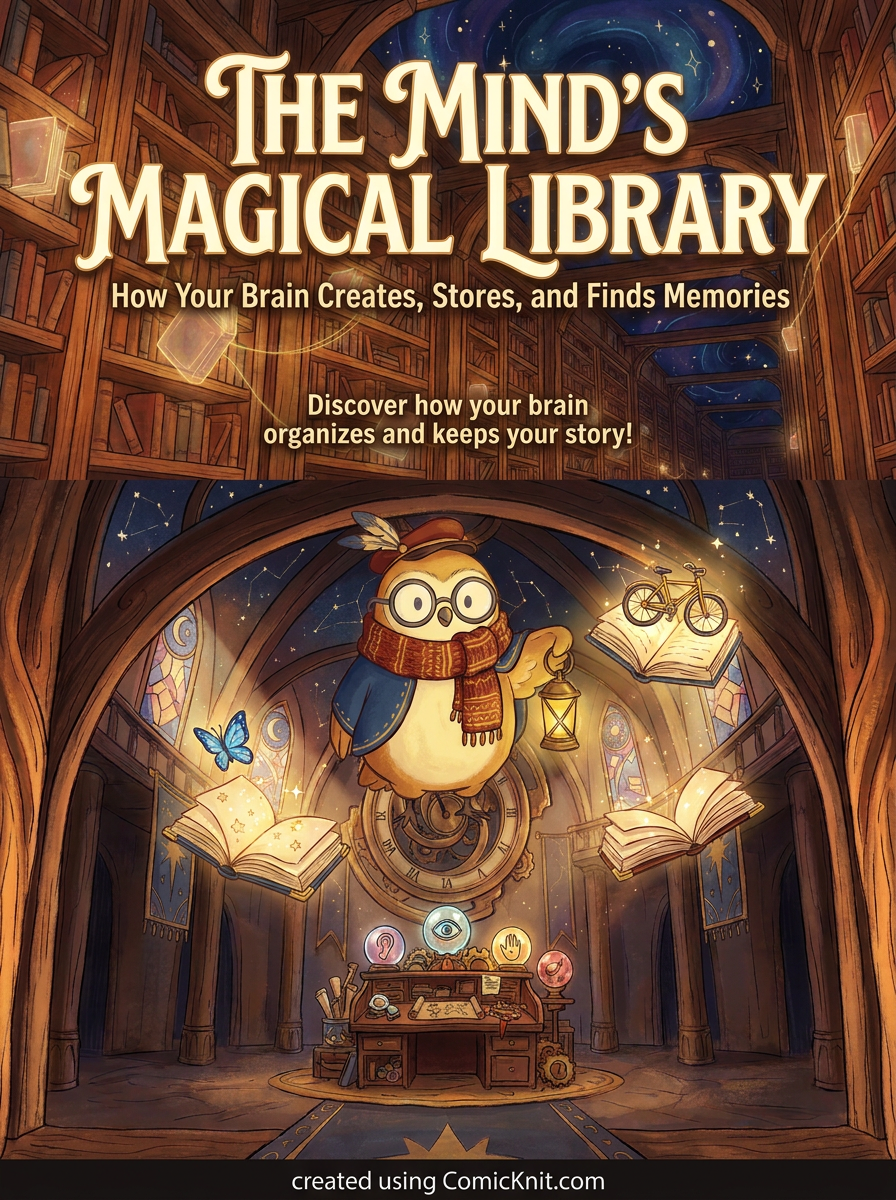
Discover how your brain acts as a clever librarian—organizing experiences, storing facts, and fetching memories when you need them.
Read the transcript(text of every page of The Mind's Magical Library)
Key facts
- The brain can be conceptualized as a vast library that creates memory books from sensory experiences.
- Paying attention, repetition, or strong emotions make the brain more likely to save a memory.
- Working memory holds information temporarily, like a tiny desk, such as holding a phone number long enough to type it.
- Long-term memory stores facts, personal experiences, physical skills, and emotional connections on permanent shelves.
- Memories are interconnected like a spiderweb; sensory cues like smells or music can pull a thread and trigger a memory.
- Forgetting occurs due to weak saving, retrieval difficulty, or memory overlap, helping prevent the brain from becoming overcrowded.
- Sleep allows the brain to organize and consolidate memories like a librarian shelving books.
- The brain acts like a storyteller and librarian rather than a camera, saving key pieces and connecting them together.
Page 1
Imagine your brain as a giant, magical library filled with glowing memory books created from everything you experience.
Paying attention, strong feelings, or repeating things tells your brain: 'Save this book!'
Sound effect: SHIMMER!
Page 2
Working memory is your brain's temporary workbench. It holds fast details long enough for you to use them.
Long-term memory stores everything else: facts you learn, bike riding skills, and cherished moments.
Page 3
Memories are connected like a glowing spiderweb! A single sensory trigger—like a familiar scent—pulls a golden thread across long-term storage.
Sound effect: PING!
Forgetting isn't a mistake. Clearing out unused details keeps our library tidy, uncrowded, and efficient for new experiences.
Sound effect: SWOOSH...
Page 4
Sleep acts as the ultimate maintenance shift, allowing Lumi to consolidate memories into long-term storage.
Your brain isn't just a passive camera—it's an active storyteller, crafting the grand story of you with every new volume.