
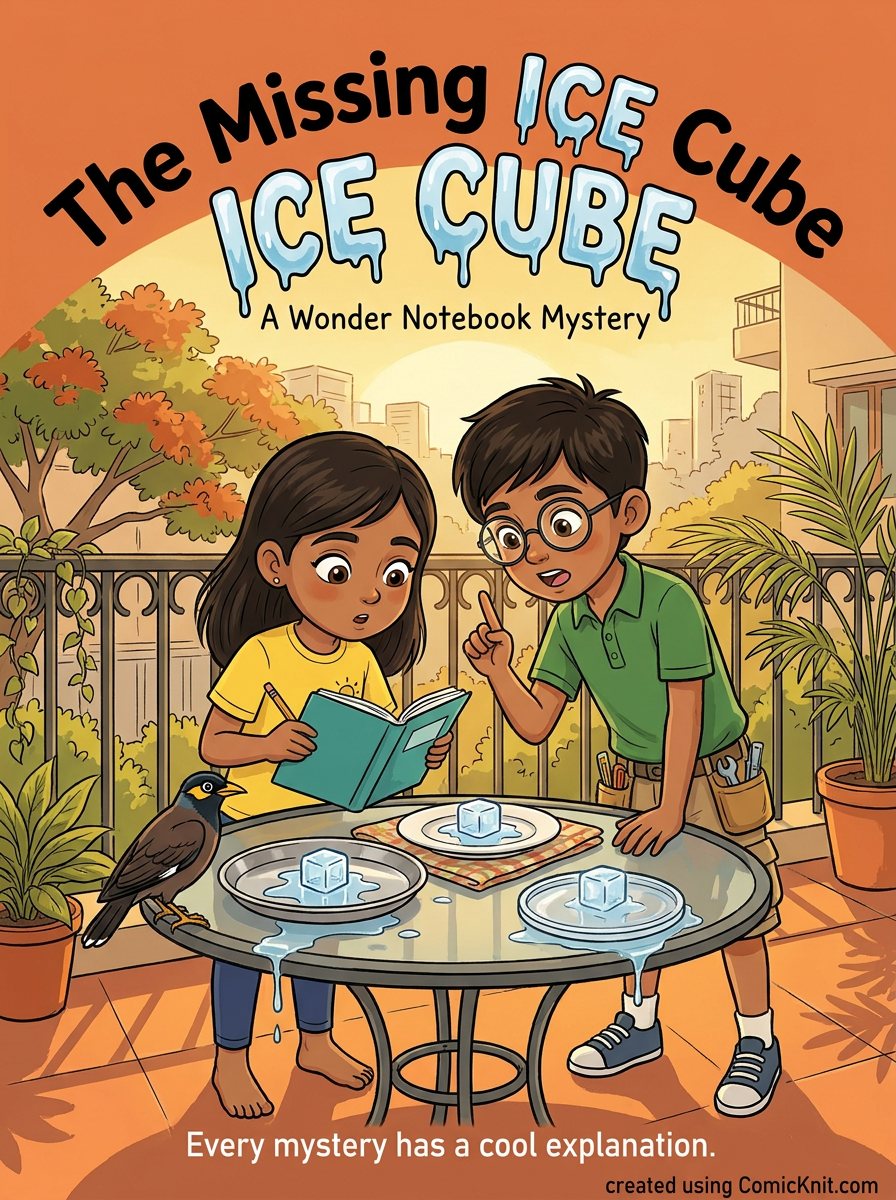
The Missing Ice Cube
A Wonder Notebook Mystery
On a sweltering Bangalore afternoon, eight-year-old Tara notices her ice cube vanished from her steel tumbler far too quickly. With her gadget-loving neighbor Kabir and a watchful myna named Nila, Tara uses her Wonder Notebook to conduct a fair test and uncover the hidden science of heat transfer.
Read the transcript(text of every page of The Missing Ice Cube)
Page 1
Indiranagar, Bangalore. 2:47 PM. The hottest part of the day.
Sound effect: drip
Tara: I put a perfectly good ice cube in here two minutes ago.
Tara: Now it's just... gone. Where did it go?
Nila: Clink! Clink!
Page 2
Kabir: Tara! I heard you. I know EXACTLY what happened to your ice cube.
Tara: Kabir. You arrived thirty seconds ago.
Kabir: A Heat Ghost. Obviously. An invisible thermal entity absorbed your ice cube.
Kabir: Highly optimized. Structurally undetectable. Classic Heat Ghost behavior.
Tara: Kabir. A real explorer gathers clues first. Then guesses.
Tara: I'm writing the mystery. 'The Case of the Fast-Melting Ice.'
Nila: Hot! Hot!
Page 3
Tara: For a fair test, we need three different surfaces: steel, cloth, and plastic.
Tara: We put ice on each one and see which melts fastest.
Kabir: Steel plate, check! Plastic tray, check! Cloth, check!
Kabir: Experiment materials fully optimized. Let's go!
Tara: Same size cubes. That's important. If anything is different, the test isn't fair.
Page 4
Kabir: Set! Timer starting now!
Nila: Hot! Hot!
Kabir: Yes! Plastic is winning — the ice on it is barely melting!
Tara: Wait.
Tara: The steel is in the sun. The plastic is in the shade. That's not the same.
Page 5
Tara: Kabir, a fair test means we change only ONE thing at a time.
Tara: The surface is what we're testing. So everything else — sunlight, ice size, time — must be the same.
Kabir: Oh. We were testing the sun, not the plates. That's... actually a bad test.
Tara: Now we reset. Fresh ice, all in the shade. Same conditions. Then we watch.
Kabir: Resetting the experiment. Fully recalibrated.
Page 6
Kabir: One minute. Steel: definitely smaller. Cloth: a little smaller. Plastic: almost the same!
Tara records what she sees — not what she expects. That's the rule.
Nila: Melting! Melting!
Kabir: Tara! The steel one is GONE. Cloth is almost gone. Plastic is still there!
Page 7
Tara: Heat always moves from something warmer to something colder.
Tara: Steel conducts heat really well. It grabs warmth from the air and passes it to the ice fast.
Tara: Cloth and plastic are poor conductors — they slow the heat down.
Kabir: So steel is like a super-fast delivery guy bringing heat to the ice — and plastic is a really slow one!
Kabir: And the ice makes the heat, so it disappears!
Tara: Almost! The ice doesn't make heat. The heat comes FROM the air around the steel.
Tara: The ice melts because it receives that heat. Getting it wrong is fine — that's how we improve!
Nila: Melting!
Page 8
A problem! And they already know exactly what is causing it.
Kabir: Amma says the frozen peas are defrosting on the metal tray too fast!
Kabir: Move them OFF the steel tray. Put the peas on a cloth instead!
Kabir: Cloth is a poor conductor — it slows the heat. The peas stay cold longer!
Kabir: Science: applied. Peas: saved.
Tara: Writing it down. This is evidence that our explanation works in real life!
Page 9
Science isn't only in labs. It's in every chai cup, every hot pavement, every shadow at 2 PM.
Heat moves from warm to cold. From the air to the steel, from the steel to the ice.
Tara: It's happening on every rooftop, every cup, every balcony railing in this city right now.
Page 10
Three lines. All the science you need.
Kabir: And remember: check the evidence! Don't just believe the Heat Ghost.
Nila: Hot! Hot! Melting!
One question answered. A hundred more waiting. That's the best part.
Tara: Wait. Why is that leaf twitching when the air is completely still?
Tara: New mystery.