
The Secret Circuit: How Batteries Power Your Toys
A Visual Journey Into Electrons, Loops, and Motors
You will see how tiny invisible charges move in closed loops to bring battery-powered toys to life, and learn how to figure out why a stopped toy isn't running.
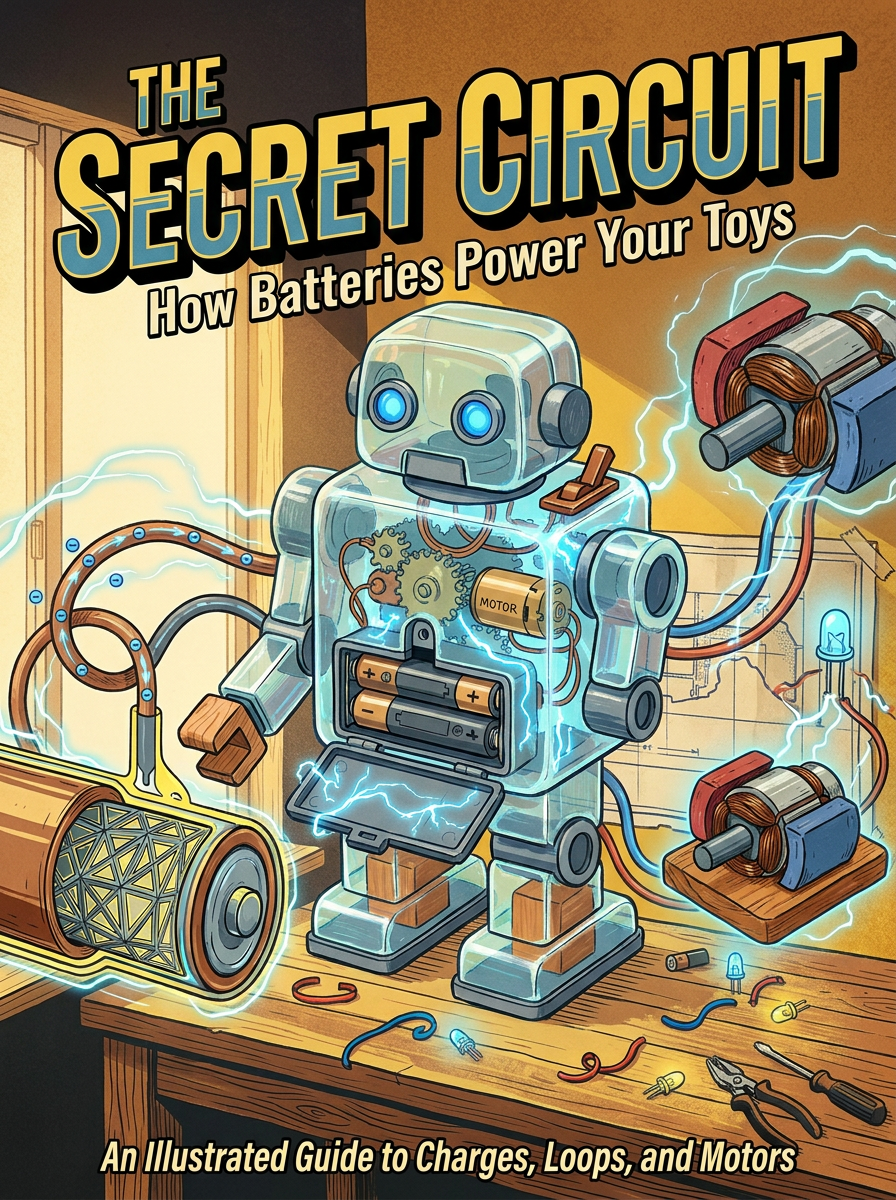
Read the transcript(text of every page of The Secret Circuit: How Batteries Power Your Toys)
Key facts
- Copper metal contains unbonded outer electrons that move freely between copper atoms even when no battery is attached.
- Electric current requires an unbroken conductive path forming a continuous loop (circuit) between battery terminals.
- AA chemical batteries generate electrical pressure (voltage) through chemical reactions between internal materials.
- An electrical switch operates by physically touching two metallic conductors together (closing) or separating them (opening).
- Electric motors generate rotary motion because current flowing through coiled wire creates temporary magnetic fields that push against permanent magnets.
Page 1
When you click the switch on a toy robot, it marches across the floor. But what is moving inside the wires to make that happen?
To find out, we have to look deeper than human eyes can see—straight inside the solid metal.
Page 2
Copper wire is not an empty pipe waiting to be filled. It is already packed with trillions of tiny negatively charged particles called electrons.
Even with no battery attached, these unbonded electrons aren't still—they jiggle randomly in every direction, canceling each other out.
Sound effect: ZAP-ZAG
Page 3
Connecting a single wire to the toy does nothing. Even with a battery attached, the electrons inside the copper wire refuse to move.
To make electric current flow, you need an unbroken path from one end of the battery to the other. This continuous loop is called a circuit.
Sound effect: BZZZ!
If the loop breaks anywhere, the electrons stop marching everywhere instantly. But what gives electrons the push to travel around this loop?
Page 4
Where do the electrons get the energy to start marching around the circuit? That is the job of the battery.
Inside this metal casing, chemical reactions build up internal pressure—ready to push charges around an open path.
Page 5
A battery does not create electricity out of nothing. Like a water pump in a closed fountain, it pushes charges that are already inside the wire.
Internal chemical reactions generate electrical pressure—or voltage—forcing charges out the negative end and pulling them back through the positive pin.
Because the loop is closed, every electron steps forward together. But what happens if you turn the battery around inside the toy?
Page 7
CHAPTER 3: CONTROLLING AND USING THE FLOW To control the moving electrons, we don't destroy their energy—we simply open or close a physical bridge along their circular path.
A switch operates by physically touching two metallic conductors together or separating them. In the OFF position, the gap stops electron flow instantly. In the ON position, the metal bridge completes the continuous loop.
Sound effect: CLICK!
Page 8
When electrons flow through the motor's coiled copper wire, the coil becomes a temporary electromagnet with its own magnetic poles.
This temporary magnetic field pushes and pulls against the stationary permanent magnets mounted inside the motor housing.
In an instant, invisible electric current becomes magnetic force, and magnetic force becomes rapid physical rotation.
Page 9
Energy changes forms along the path! Chemical energy becomes moving electrical energy, which turns into magnetic forces that make mechanical movement.
When the battery's internal chemicals finish reacting, the chemical pump stops pushing—and the entire chain of energy transformation grinds to a halt.
Page 10
When a battery-operated toy stops working, you don't need magic to fix it. You just need to check the three main parts of the circuit loop!
By systematically testing the pump, the path, and the bridge, you can pinpoint exactly where the flow of electrons has been interrupted.
Every stopped toy is just a puzzle waiting for an investigator. Ready for your first case files as a circuit detective?
Page 11
Every quiet toy reveals its secret to a circuit detective: a reversed battery pump, a broken wire loop, or a blocked switch bridge.
When the loop is closed, chemical pressure pushes, the switch connects, wires carry the flow, and the motor transforms electric energy into spinning motion.
Once you know how electrons flow through closed loops, you hold the secret behind how every battery-powered toy brings its world to life!
Sound effect: VZZZZ!