
Time Detectives: How We Date Ancient Pots and Dinosaur Fossils
Unlocking Earth's Natural Clocks from Soil Layers to Volcanic Ash
An educational visual narrative explaining how archaeologists and paleontologists determine the exact ages of human artifacts and ancient dinosaur bones using rock layers, carbon clocks, and volcanic ash.
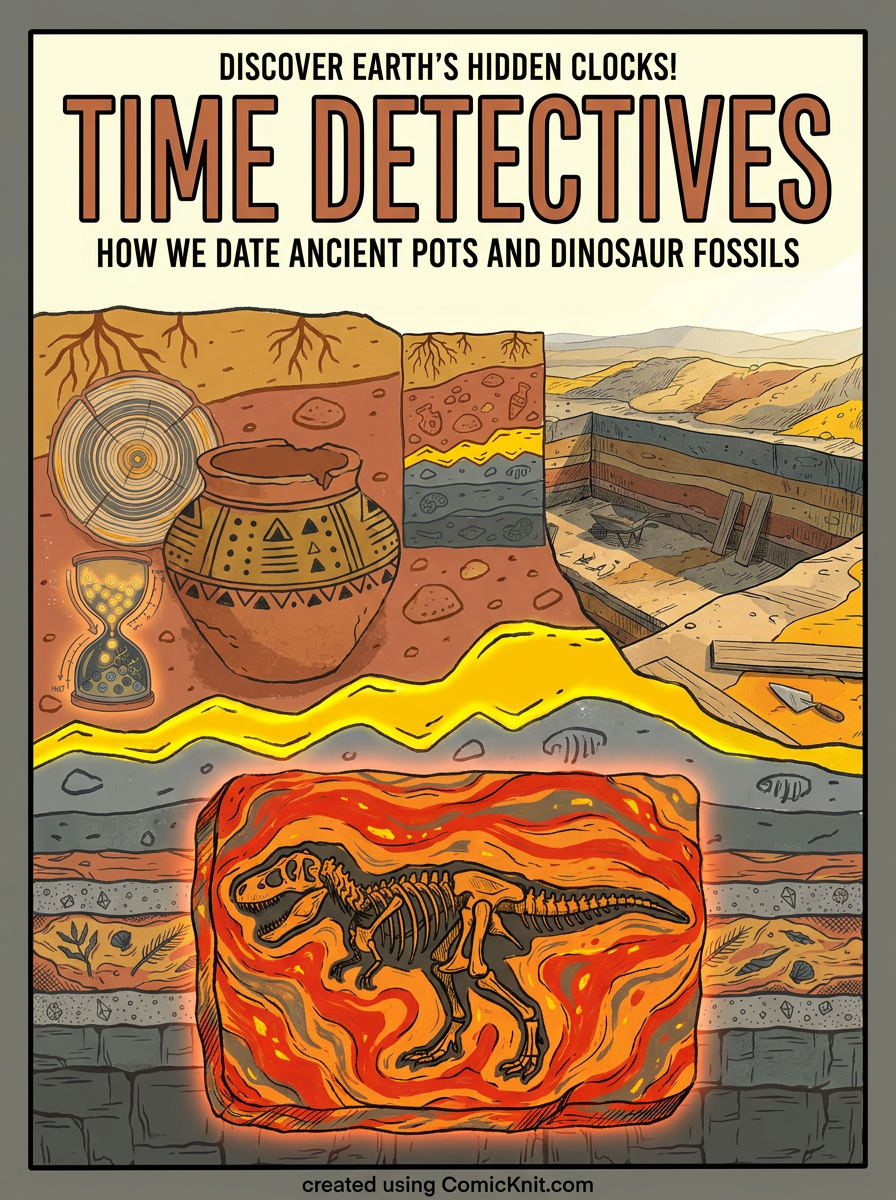
Read the transcript(text of every page of Time Detectives: How We Date Ancient Pots and Dinosaur Fossils)
Key facts
- In undisturbed soil or rock, deeper layers were deposited earlier and are older than upper layers.
- Carbon-14 decays with a half-life of 5,730 years and can date organic materials up to about 50,000 years old.
- Carbon dating cannot date dinosaur fossils because all original Carbon-14 completely disappears after 50,000 years.
- Scientists date dinosaur fossils by radiometrically dating volcanic ash layers above and below the fossil bed.
Page 1
When an archaeologist digs up an ancient clay pot, or a paleontologist finds a giant dinosaur bone, how do they know its age?
Human history spans thousands of years. Dinosaurs lived millions of years ago. To read both stories, scientists use Earth's hidden clocks.
Page 2
Chapter 1: Which Layer Came First? Imagine stacking laundry in a basket every day. Today's clothes sit on top. Monday's clothes stay at the bottom.
Soil builds up over time. Unless the ground was stirred, deeper soil layers were laid down earlier. This rule is called the Law of Superposition.
Try it! If Object A is found in Layer 1 near the grass, and Object B is buried deep in Layer 4, which object was buried first?
Page 3
Soil layers show which thing is older, but not the exact year. For exact dates on wood, scientists look for nature's built-in calendars.
Trees add one new growth ring every year. Wide rings mean wet years; narrow rings mean dry years. Matching these ring patterns gives an exact calendar year!
Page 4
Chapter 2: How Organic Clocks Tick. Every living plant and animal absorbs Carbon-14 from the air while it lives and grows.
When a tree dies or a bowl is carved, it stops taking in Carbon-14. The trapped Carbon-14 decays into Nitrogen at a steady rate: half decays every 5,730 years.
Application test: A wooden spoon found in a cave has exactly half the Carbon-14 of a fresh branch. How old is the spoon?
Page 5
Chapter 3: Why Carbon Dating Can't Date Dinosaurs. Misconception alert: Many people think scientists use carbon dating on dinosaur bones!
After 50,000 years, virtually all Carbon-14 in a sample has decayed away! Dinosaur bones are over 66 million years old - 1,300 times beyond carbon's limit.
Page 6
Furthermore, dinosaur bones are fully petrified - turned into rock! To date rock layers millions of years old, geologists need a much longer clock.
Page 7
Chapter 4: The Volcanic Sandwich. Volcanic eruptions blast ash containing radioactive potassium and uranium crystals across the land.
Volcanic rock contains super-slow clocks like Potassium-40, which takes 1.25 billion years for half to decay! Geologists date these volcanic ash layers directly.
Page 8
Fossils themselves rarely contain volcanic minerals. But when a dinosaur is trapped between two volcanic ash beds, geologists date both ash layers!
If the bottom ash layer is 68 million years old and the top ash layer is 66 million years old, the dinosaur buried between them must be between 66 and 68 million years old!
Page 9
Your turn as a Time Detective! You discover a Triceratops fossil. The ash layer below it is 70 million years old. The ash layer above it is 68 million years old. How old is the fossil?
Page 10
The same secret works everywhere! Scientists also count ice layers in Antarctica to date ancient climate trapped in bubbles.
Whether using soil layers for clay pots, carbon clocks for charcoal, or volcanic brackets for dinosaurs - Earth preserves its story for those who learn to read its clocks!