
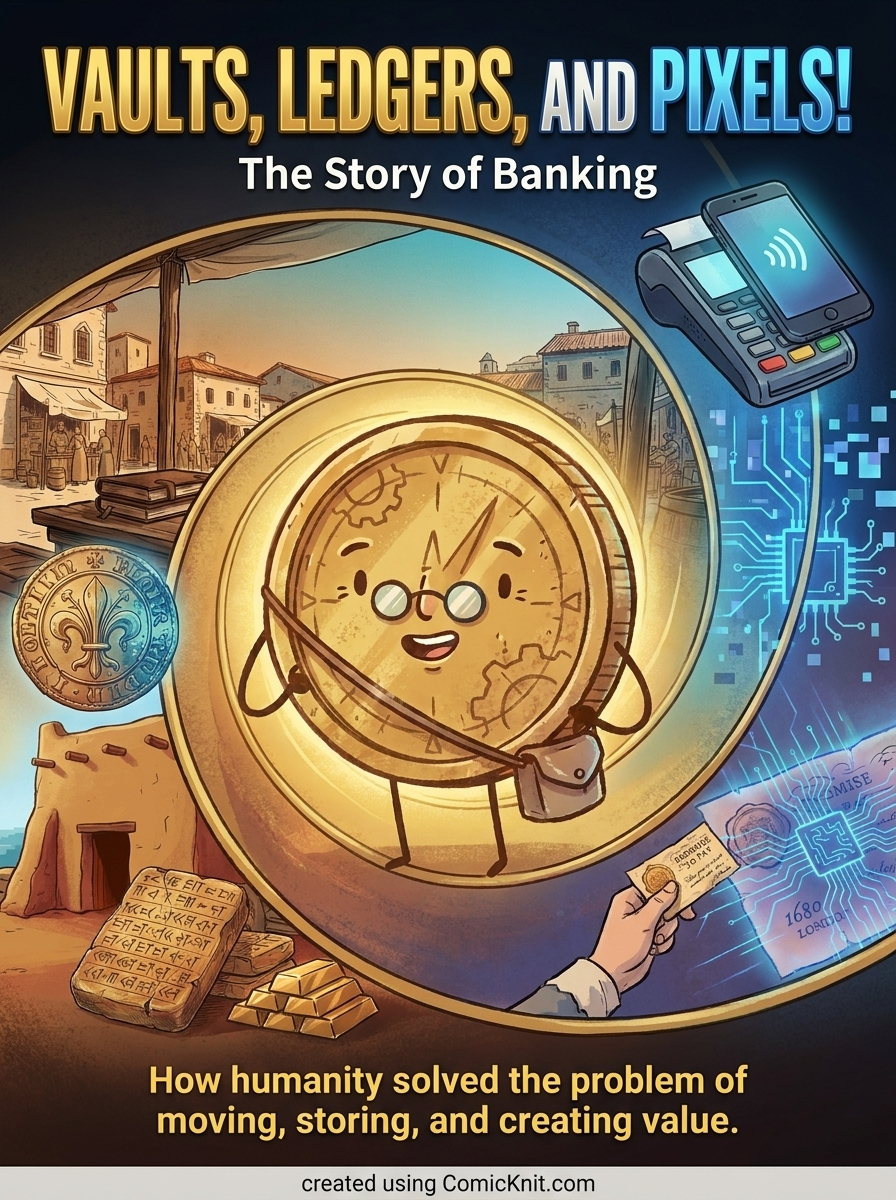
Vaults, Ledgers, and Pixels: The Story of Banking
How humanity solved the problem of moving, storing, and creating value across thousands of years.
Discover how banking evolved from ancient grain temples to modern digital networks, solving the fundamental friction of global trade.
Read the transcript(text of every page of Vaults, Ledgers, and Pixels: The Story of Banking)
Key facts
- Before coined money, early Mesopotamian temples functioned as proto-banks by storing grain and livestock and recording transactions on clay tablets.
- Early banking solved core problems of secure storage, long-distance trade risk, and the inefficiency of direct barter.
- Renaissance Italian merchants created double-entry bookkeeping and letters of credit, allowing money to move across Europe without physically carrying gold.
- The word 'bank' derives from 'banco,' the wooden bench or counter used by Italian moneylenders in open marketplaces.
- London goldsmiths in the 1600s stored gold for customers and issued paper receipts that began circulating directly as cash.
- Fractional reserve banking emerged when institutions realized not all depositors withdrew their gold at once, allowing them to issue loans against deposited assets.
- Modern banking operates largely through electronic ledgers, where physical currency accounts for only a small fraction of total money supply.
Page 1
Before money existed, trade meant direct barter. Imagine carrying hundreds of pounds of wheat just to buy basic tools!
To solve this, ancient Mesopotamian temples acted as early banks, storing grain safely and recording deposits on cuneiform clay tablets.
By replacing physical goods with trusted receipts, humanity overcame the friction of storage, theft, and long-distance travel.
Page 2
Chapter 2: The Bench of Florence. By the 14th century, trade expanded across Europe, but hauling heavy gold across bandit-filled roads was far too risky.
Italian merchants invented letters of credit and double-entry bookkeeping. A merchant could deposit gold in Florence and withdraw value in Venice using paper alone.
Fun Fact: The word 'bank' comes from 'banco'—the Italian word for the wooden bench where money changers sat in open market squares!
Page 4
Today, banking has shifted from physical vaults to instant electronic ledgers, where physical currency is only a fraction of global money.
Whether storing grain in ancient Sumeria, issuing letters in Florence, or tapping a phone today, banking remains humanity's core trust network.
So next time you swipe, tap, or trade, remember—you are participating in thousands of years of human ingenuity and trust!