
Dad Explains: Where Does Money Sleep at Night?
A LearnWithDad Adventure into the Story of Money
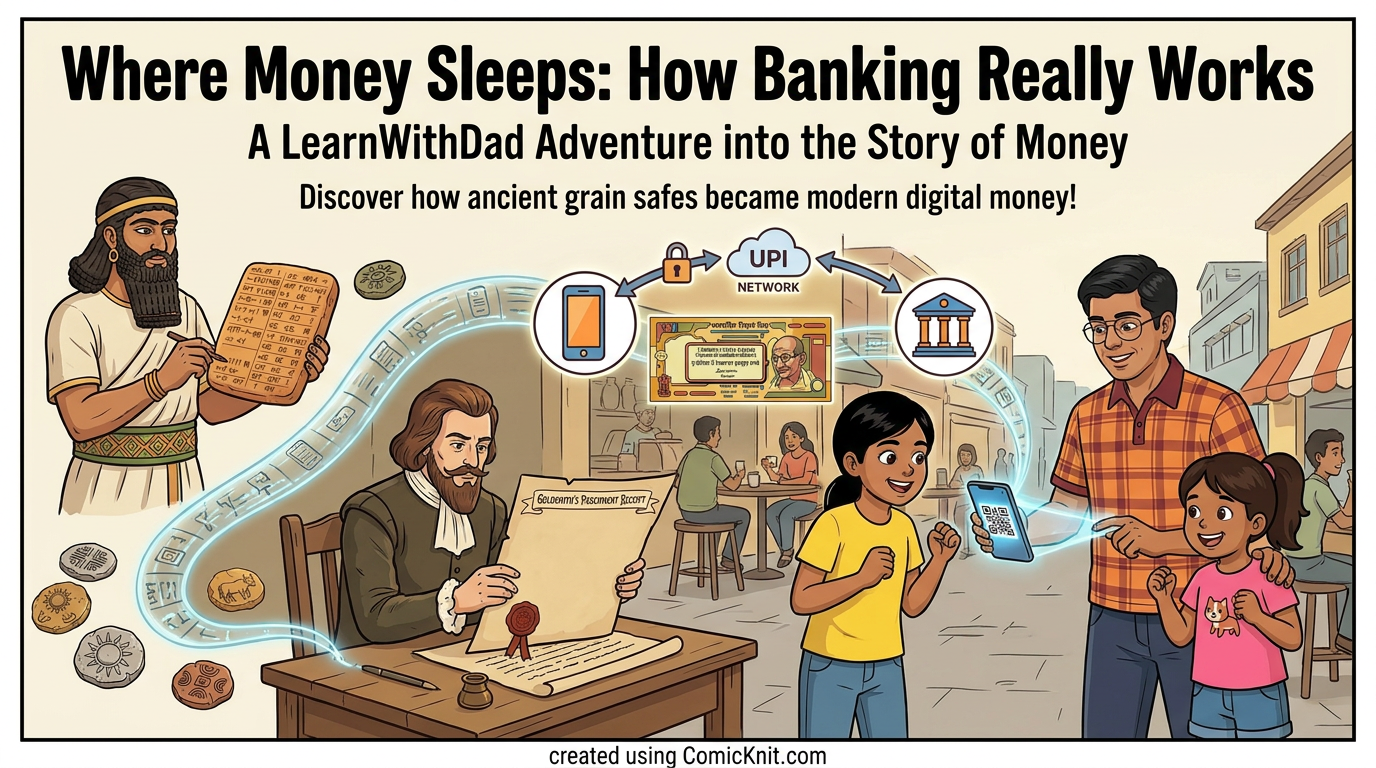
Through a time-traveling journey from ancient Mesopotamian grain stores to modern digital UPI payments, Dad teaches Swara and Dakshu how money transforms from physical stuff in a box into a network of shared trust and working credit.
Read the transcript(text of every page of Dad Explains: Where Does Money Sleep at Night?)
Key facts
- Ancient Mesopotamian temples stored grain in central granaries and issued recorded clay tablets as receipts.
- Punch-marked silver coins were among the earliest official currencies in ancient India, stamped by authorities to guarantee weight and purity.
- European goldsmiths in the 17th century issued paper receipts for gold deposits, which merchants began trading directly as early paper money.
- Fractional-reserve banking relies on the observation that only a small percentage of depositors withdraw cash on any given day, allowing the rest to be lent out.
- A bank run occurs when widespread panic causes depositors to demand their cash simultaneously, exceeding the physical cash held in reserve.
- Indian Rupee notes carry an explicit pledge signed by the RBI Governor: 'I promise to pay the bearer the sum of...'
- Unified Payments Interface (UPI) transfers move digital balance records between bank computer ledgers instantly without physical currency movement.
Page 1
Swara: My first official pocket money! I'm sliding this straight into my wooden desk drawer for safe keeping.
Dad: A desk drawer? That's nice, but is it really safe from curious little sisters?
Dakshu: Ha! I hide mine inside my shoe! Nobody steals stinky shoes!
Swara: Until Mummy washes them and your money turns into wet soup!
Sound effect: STUFF!
Dakshu: Papa... where DOES money sleep at night if not in shoes?
Dad: People have been asking that exact question for four thousand years! Ready to travel back in time to find out?
Page 2
Before money existed, direct trade—or barter— required an exact match of desires.
Dad: Greetings, craftsman! One fine goat in exchange for ten clay grain pots?
Swara: He already has three goats behind his stall, Papa.
Sound effect: BLEEEAT!
Economists call this obstacle the Coincidence of Wants.
Swara: If he doesn't want a goat, you get no pots! Both people have to want what the other person is holding.
Barter also fails because large assets like animals cannot be divided into smaller payments.
Dakshu: I only want one sweet drink! Can we cut off half a goat tail for change?
Dad: Dakshu, put that saw down! You cannot slice up live livestock to make small change!
Page 3
Dad: Instead of keeping grain at home where pests steal it, ancient farmers pooled crops in one guarded temple vault.
Dakshu: So it's a giant communal grain cupboard!
Ancient Mesopotamian temples stored grain in central granaries and issued recorded clay tablets as receipts.
Swara: Hey, that stamped tablet is just a baked clay bank statement!
Swara: The clay receipt lasts forever, but real grain rots after a few months.
Dad: Exactly. So what non-perishable token could people trade instead of bulky food?
Page 4
Ancient India, c. 300 BCE.
Dad: Since grain rots, people needed metal! But raw metal had to be weighed every single time.
Punch-marked silver coins were among the earliest official currencies in ancient India, stamped by authorities to guarantee weight and purity.
Swara: So the king stamped these marks to prove the weight and purity?
Dakshu: Look! My official leaf coin buys one hundred ice creams!
Swara: Dakshu, nobody trusts a crayon leaf!
Dad: Exactly. Money isn't just metal or leaf—it is official shared trust.
Dad: But what happened when carrying heavy bags of metal coins became too dangerous?
Page 5
Dad: Gold coins were heavy to haul around. So merchants paid goldsmiths a small fee to lock their metal in strong iron safes.
Dakshu: Like a big dragon cave!
Sound effect: CLANK!
European goldsmiths issued paper receipts for gold deposits. Merchants soon realized trading these paper receipts directly was much easier than hauling heavy metal.
Swara: Wait! If everyone accepts the paper receipt, nobody ever needs to fetch the actual gold!
Dad: Bingo. That paper receipt is the direct ancestor of modern banknotes.
Dakshu: So all that gold just stays inside the safe sleeping forever?
Dad: It did... until goldsmiths noticed something surprising about those sleeping coins.
Page 6
Most gold rested silently in the iron safe day after day.
Dad: The goldsmith noticed something big: depositors almost never withdrew all their gold at once.
Fractional-reserve banking relies on the observation that only a small percentage of depositors withdraw cash on any given day, allowing the rest to be lent out.
Swara: So if nine out of ten coins sit idle, he can safely lend them out!
Money left sleeping in a safe puts the whole town to work.
Dakshu: Wait! He lent MY resting gold to a total stranger?!
Dad: Yes! And that lent gold helped build a bakery that earns extra income.
Page 7
Interest powers a circular engine: deposits fund real work, generating new wealth for everyone.
Dad: The bank lends your deposit to a baker to buy an oven. He bakes bread, earns profit, and pays back the loan plus extra interest!
Dakshu: My idle money helps bake real fresh bread? Yum!
Every financial system rests on a delicate promise: borrowers must repay on time.
Swara: Wait, Papa... what happens if the baker burns all his bread and can't pay the loan back?
Dad: That's credit risk! If loans fail, the bank loses funds...
Page 8
When trust breaks, a normal trickle of withdrawals turns into a wild flood called a bank run.
Dad: If a rumor starts that the baker can't pay, everyone rushes to get their cash out at once.
Dakshu: Hey! Stop pushing! Is my money in there?
Sound effect: RUMBLE RUMBLE
Swara: Because ninety percent of the cash was lent out to build ovens, the bank runs dry!
Dad: Exactly. The bank is healthy, but it lacks instant cash for everyone simultaneously.
Dakshu: Papa! I'm putting my rupees back inside my shoe forever!
Dad: Don't worry! Governments saw this chaos and created a ultimate referee to protect us.
Page 9
Dad: To prevent panic, every country built a referee—a Central Bank like the Reserve Bank of India.
Swara: Look! It says: 'I promise to pay the bearer the sum of one hundred rupees'—signed by the Governor!
Swara: It's just like the 17th-century goldsmith receipt, but backed by the whole nation!
Dad: The referee forces banks to keep cash reserves, insures deposits, and lends money if trouble hits.
Dakshu: So the referee keeps our piggy banks safe even during a scare!
Page 10
Dad: See that? The milk is paid for, but not a single rupee note changed hands.
Dakshu: Where did the money go then? Did it fly through the air?
Sound effect: PING!
Unified Payments Interface (UPI) transfers move digital balance records between bank computer ledgers instantly without physical currency movement.
Dakshu: I solved it! Money doesn't sleep in a shoe... it sleeps as computer numbers working in banks!
Swara: So paper notes are just one way to carry proof!
Dad: Exactly. But tell me—why does cash sitting still inside a shoe slowly lose its buying power over time?
Page 11
Dad: Ten years ago, a crisp note bought four of these samosas. Today, that same note gets you just one.
Dakshu: Hey! Who stole three samosas from my note?
Inflation is the gradual decrease in what a single unit of currency can buy over time as general prices rise.
Swara: So cash stuck under a mattress loses buying power! But bank interest helps your money grow faster than prices.
Dakshu: Golden Rule number one: Never lend your money to a shoe!
Page 12
Dad: First customer here! I would like to deposit fifty rupees in the new vault, please.
Dakshu: Welcome! No shoes allowed inside this bank!
Swara: Recorded! Five rupees stay in reserve, so forty-five can work out in the world.
The LearnWithDad home bank is open for business based on 4,000 years of trust.
Dakshu: And when you borrow back for tea, Papa, that will be two rupees interest!
Dad: Deal! Four thousand years of trust, right here on our living room floor.