
Where Did the Calendar Come From?
A Saturday Morning Journey Through Gods, Emperors, and Moon Cycles
On a cozy Saturday morning, Dad takes his daughters Swara and Dakshu on an educational journey explaining how calendar month names originated from ancient moon cycles, Roman deities, emperors, and Latin numbers.
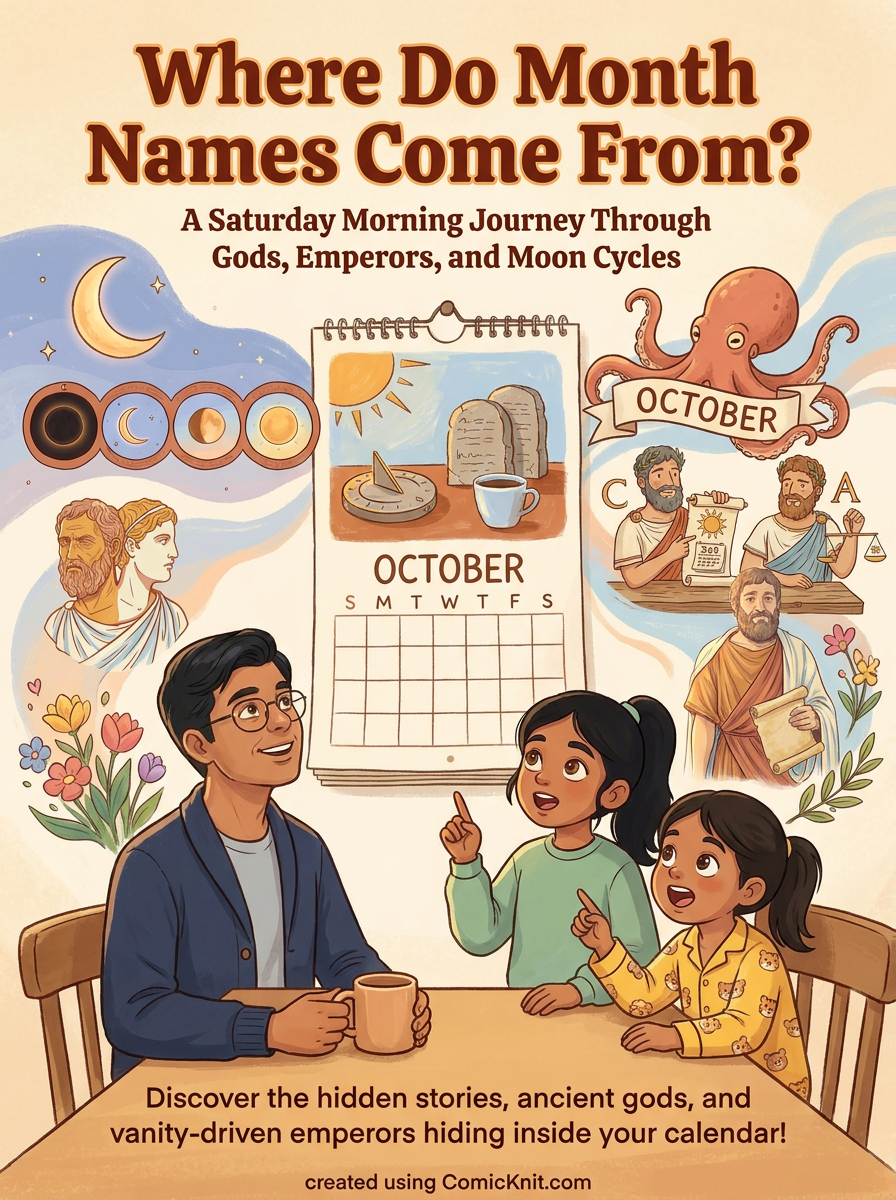
Read the transcript(text of every page of Where Did the Calendar Come From?)
Key facts
- The word 'month' derives from 'moon,' and ancient calendars measured time by lunar cycles.
- The early Roman calendar contained 10 named months, beginning in March and leaving winter as an un-named period.
- March, April, May, and June were named after Mars, aperire ('to open'), Maia, and Juno.
- King Numa Pompilius added January (named for Janus) and February (named for Februa) to fill the winter gap.
- Julius Caesar instituted the 365-day solar Julian calendar and renamed Quintilis to July.
- Emperor Augustus had Sextilis renamed August and added a day taken from February so August matched July's 31 days.
- September, October, November, and December derive from Latin roots for 7 (septem), 8 (octo), 9 (novem), and 10 (decem).
- Pope Gregory XIII established the Gregorian calendar in 1582 to correct solar drift using leap years.
Page 1
Saturday morning at the table.
Dakshu: Dad, who picked the word 'July'? It doesn't sound like a real word at all!
Swara: It's just what calendars have always said, Dakshu. People didn't just invent month names.
Behind every page on the wall lies thousands of years of secret history.
Dad: Actually, someone did invent them! Every month on that wall is part of a ancient mystery involving Roman gods, vain emperors, and giant math mistakes.
Dakshu: Vain emperors?!
Page 2
The word 'month' derives directly from 'moon'—a natural cycle of sky time.
Dad: Before paper calendars, ancient people looked up. The moon grows from a thin silver sliver to full glow every twenty-nine and a half days.
Dakshu: It's like a giant glowing clock in the sky!
Swara: So twelve moon cycles make almost a full year, but twelve moons don't perfectly equal three hundred and sixty-five sun days!
Dad: Exactly. And when early Romans tried to build a calendar around farming instead of exact astronomy, things got weird.
Page 3
In early Rome, time was bound strictly to the agricultural cycle of crops.
Dad: The early Roman calendar only had 10 named months, starting in March when farming began.
Swara: Wait, it started in March? What happened to January and February?
Swara: So winter was just completely ignored? It didn't even have a name?
Dakshu: Brrr! Unnamed freezing snow time!
Dad: Since farming paused in winter, they didn't count those sixty days until spring returned.
Dakshu: So who named those original spring months when the year finally started?
Page 4
March, April, May, and June were named after Mars, aperire ('to open'), Maia, and Juno.
Dad: When spring arrived, early Romans named March after Mars, their war god, as soldiers marched back into battle.
Dakshu: So March comes from a superhero god?
Dad: Exactly. Next came April, from 'aperire'—Latin for 'to open'—as flower buds unlocked.
Swara: And May comes from Maia, goddess of growing plants! Everything blooms in May!
Dad: Spot on, Swara! And June honors Juno, protector of families and youth.
Dakshu: Wait... if spring had four god months, what about that cold, unnamed winter gap?
Page 5
King Numa Pompilius added January (named for Janus) and February (named for Februa) to fill the winter gap.
Dad: Around 700 BCE, King Numa Pompilius filled that freezing winter gap by adding two new months: January and February.
Dakshu: So winter finally got its own official spot!
Swara: Janus has two faces! One looks back at where you came from, and one looks forward to where you're going.
Page 6
Julius Caesar instituted the 365-day solar Julian calendar and renamed Quintilis to July.
Dad: Julius Caesar fixed the calendar to 365 solar days and renamed Quintilis to July after himself!
Dakshu: So July got its name from a real emperor!
Emperor Augustus renamed Sextilis to August and added a day taken from February so August matched July's 31 days.
Swara: Wait, August was jealous of July having 31 days?
Dakshu: Poor February! He stole a day right out of it!
Dad: Exactly! Augustus renamed Sextilis to August and took a day from February so his month was just as long.
Sound effect: SNATCH!
Page 7
The original 10-month names stayed, even after their positions changed.
Dad: September, October, November, and December come from Latin roots septem, octo, novem, and decem—meaning 7, 8, 9, and 10!
Dad: When January and February were pushed to the front, those numbered months shifted two spots down!
Dakshu: Octo like an octopus! An octopus has eight legs, so October was month eight!
Swara: And decem means ten, like ten years in a decade!
Dad: Brilliant linguistic detective work, girls!
Swara: So how did this ancient Roman setup turn into the exact calendar on our wall today?
Page 8
Pope Gregory XIII established the Gregorian calendar in 1582 to correct solar drift using leap years.
Dad: In 1582, Pope Gregory XIII added leap years to fix tiny solar timing drifts, creating the Gregorian calendar on our wall!
Swara: So every single month hides thousands of years of human stories!
Dakshu: I'm still drawing eight octopus legs on October!